Traveling between Guatemala, El Salvador and Honduras means crossing a history that does not stop at today’s borders. The cities change, the landscapes too, but a common thread links the former colonial capitals, the first Spanish settlements, the republican squares, the markets and the fortresses facing the Caribbean.
This ten-day itinerary offers a cultural approach to Central America, following the traces of several periods: pre-Hispanic worlds, the Spanish conquest, the organization of colonial power, independence movements and the construction of modern states. The route is not limited to visiting monuments. It helps understand how a region long seen as a set of passages, roads and exchanges continues to tell a shared story.
Antigua Guatemala, beginning with the former capital
The journey begins in Antigua Guatemala, one of the best-known historic cities in Central America. Listed as a UNESCO World Heritage Site, it occupies the site of the former Santiago de Guatemala, established in the Panchoy Valley in the 16th century. For more than two centuries, the city was one of the great centers of Spanish power in the region, before the earthquakes of 1773 led to the transfer of the capital to present-day Guatemala City.
Antigua is best discovered on foot, without trying to see everything too quickly. Around Parque Central, the arcades, low façades, former institutions and churches tell the story of a city where political, religious and economic power was concentrated in a relatively compact space. The Palace of the Captains General, the cathedral, the convents and the cobbled streets do not function as simple remains: they still give the city a very legible presence.
The church of La Merced offers one of the most recognizable examples of Guatemalan Baroque, with its elaborate façade and the remains of its former convent. In the ruins, inner courtyards and walls that remained standing after the earthquakes, Antigua keeps a particular relationship with time. Nothing there seems completely frozen. The city lives with its past, but it does not resemble a setting closed in on itself.
San Salvador, between independence and republican memory
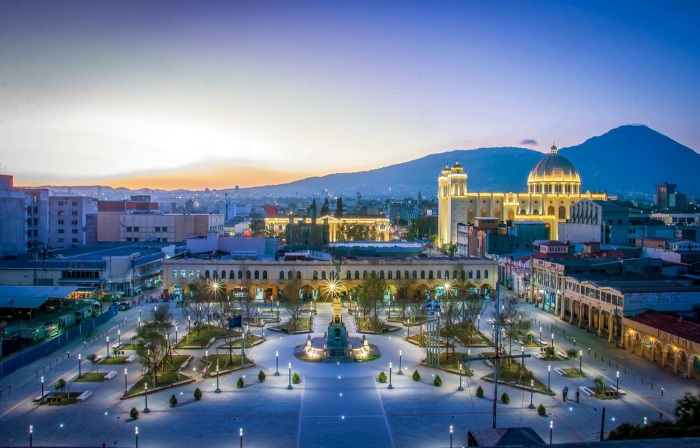
The route continues toward San Salvador. The change in atmosphere is immediate: the Salvadoran capital is denser, more urban, less heritage-focused at first glance. Yet it is in its historic center that several important landmarks can be found to understand the country’s political history.
Plaza Libertad, Plaza Gerardo Barrios, the Metropolitan Cathedral and the National Palace form an ensemble where the memory of independence, public life and republican architecture intersect. The National Palace, inaugurated in 1911, recalls another stage in the Central American narrative: that of states asserting their institutions, their symbols and their places of representation.
This stop makes it possible to avoid an overly colonial reading of the itinerary. The history of Central America does not end with the cities founded by the Spanish. It continues in modern capitals, gathering places, public buildings and the spaces where the political life of today’s countries was built.
Our article: San Salvador, the Raw Energy of an Overlooked Capital
Suchitoto and Ciudad Vieja, two ways of reading El Salvador
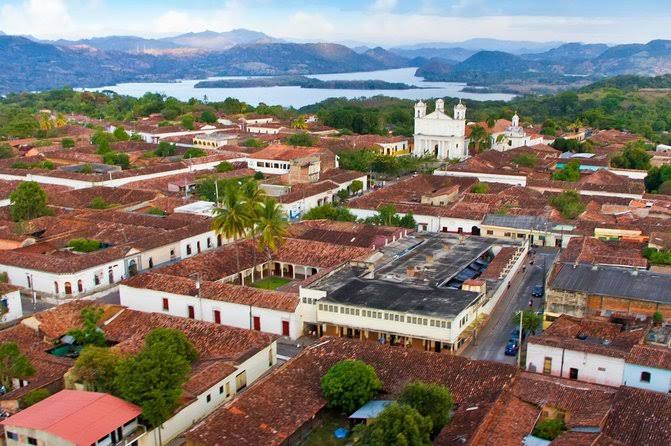
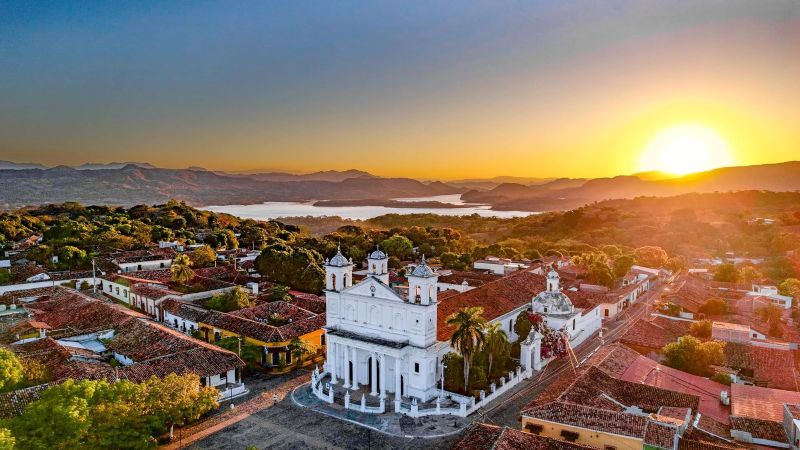
Further north, Suchitoto offers a different pace. Its cobbled streets, low houses, Santa Lucía church and workshops give the city a more intimate atmosphere than San Salvador. From its heights, the view opens onto Lake Suchitlán, formed with the Cerrón Grande reservoir. Today, the site is associated with boat trips, birdwatching and slower tourism, but its recent history also reminds us that landscapes can be deeply transformed by major development projects.
Nearby, Ciudad Vieja requires another kind of attention. The site is not discovered through large buildings still standing, but through more discreet traces: foundations, streets, fragments of a 16th-century settlement. It was at the La Bermuda hacienda that the second settlement of the villa of San Salvador was established in 1528, before being abandoned in the middle of the century.
The interest of Ciudad Vieja lies precisely in this discretion. One has to imagine the organization of a nascent city, its streets, its living spaces, its first administrative structures. This stop gives depth to Suchitoto and connects the current charm of the region to an older history, marked by the beginnings of the Spanish presence.
Gracias, a discreet city with a major role
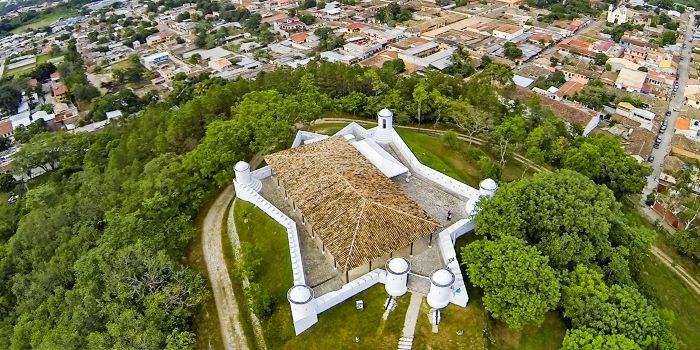
In Honduras, Gracias introduces a lesser-known but essential chapter. In 1544, the Real Audiencia de los Confines was established there to administer a large part of Central America. The city does not have the heritage reputation of Antigua, but its historical role gives it an important place in this route.
Walking through Gracias means approaching colonial history from a more modest-sized city, surrounded by the reliefs of the department of Lempira. The churches, old streets and views from Cerro de San Cristóbal recall that some places that are more discreet today nevertheless held a central position in the political organization of the region.
San Pedro Sula and the opening toward the Caribbean
The route ends in San Pedro Sula, often associated with its economic and logistical role. For a historical itinerary, the city is mainly interesting because of its position in the Sula Valley and its connection with the Honduran Caribbean coast. The Museum of Anthropology and History offers an introduction to the region’s pre-Hispanic heritage, while Guamilito market provides a more everyday approach to the city, between crafts, gastronomy and local trade.
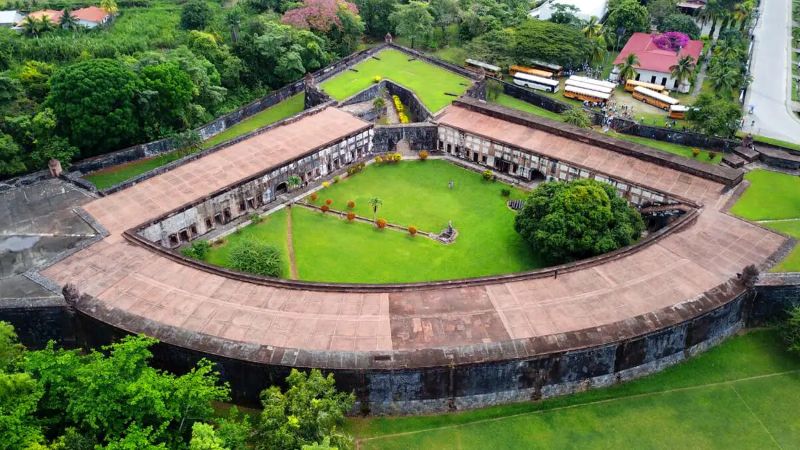
From this part of Honduras, history opens toward the sea. Built in the 18th century to protect the port of Omoa and the Gulf of Honduras, the San Fernando fortress extends the narrative onto another terrain: military defenses, maritime routes and rivalries between European powers in the Caribbean.
This final stop gives the journey a broader conclusion. After the colonial cities of the interior, the political centers and the first settlements, the coast reminds us that Central America was also a strategic space of circulation, trade and military protection.
In ten days, this itinerary therefore forms a dense but fluid cultural crossing. Antigua Guatemala, San Salvador, Suchitoto, Ciudad Vieja, Gracias and San Pedro Sula do not tell the same period, nor the same form of power. Together, however, they outline a shared regional history, made up of movements, foundations, urban memories and inhabited landscapes. That is where the value of this route lies: not in the accumulation of sites, but in the way each stop sheds light on the next.
Photos: Rafal Cichawa | El Salvador Travel | Ministerio de Cultura | Visit Centroamérica