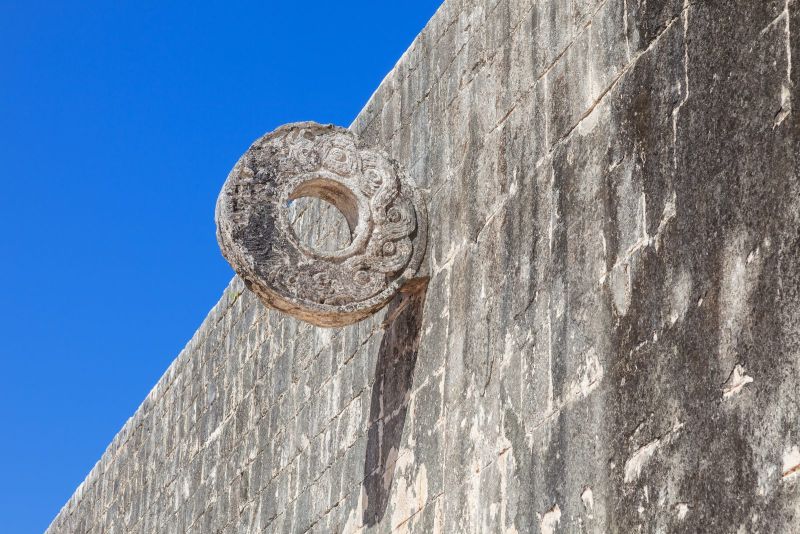
At Chichén Itzá, in Mexico, two stone rings are fixed nearly eight metres above the ground on the walls of an immense ballcourt. They bear witness to one of the oldest games in the Americas. Long before the arrival of the Spanish, the Maya, Mexica, Zapotec and other Mesoamerican peoples competed using a rubber ball. These matches attracted spectators and could also accompany major religious ceremonies.
An ancient sport
The origins of the Mesoamerican ballgame date back more than 3,000 years, probably to a region associated with the early civilisations of the Gulf of Mexico, particularly the Olmecs. Between the present-day states of Veracruz and Tabasco grew the trees from which the latex needed to make the balls was extracted. However, one of the oldest known ballcourts was discovered at Paso de la Amada, in Chiapas, and is believed to date from around 1400 BCE.
Over the centuries, the game spread throughout much of Mesoamerica. According to the National Autonomous University of Mexico (UNAM), more than 3,000 archaeological ballcourts have been documented, varying in size and shape. Some cities had several, reflecting the importance attached to the game.
The game also had different names among different peoples. Maya texts notably feature the term pitz, while in Nahuatl, the language of the Mexica, it was known as ullamaliztli.
How was the juego de pelota played?
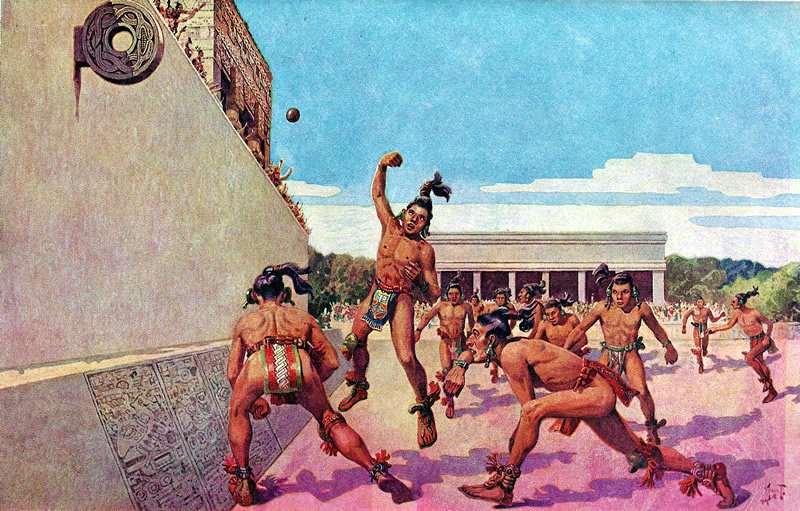
The principle seems simple but required excellent physical fitness. Two teams competed using a heavy ball that had to be kept in motion. Depending on the region and period, players had to strike it with their hips, forearms, knees or sometimes with sticks.
Impacts could be violent, hence the use of thick protective equipment around the waist and hips, sometimes supplemented by knee pads, elbow pads or chest protection.
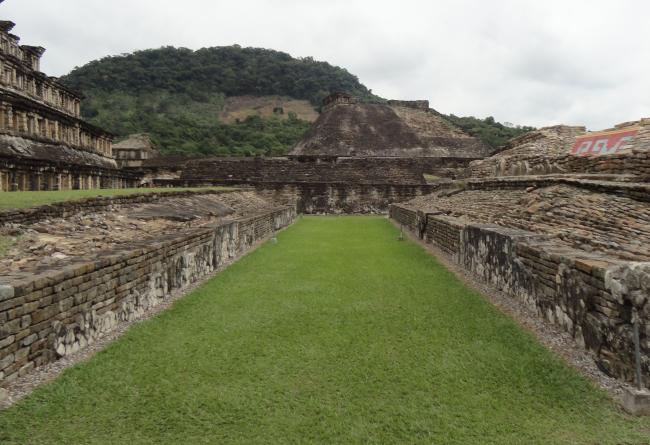
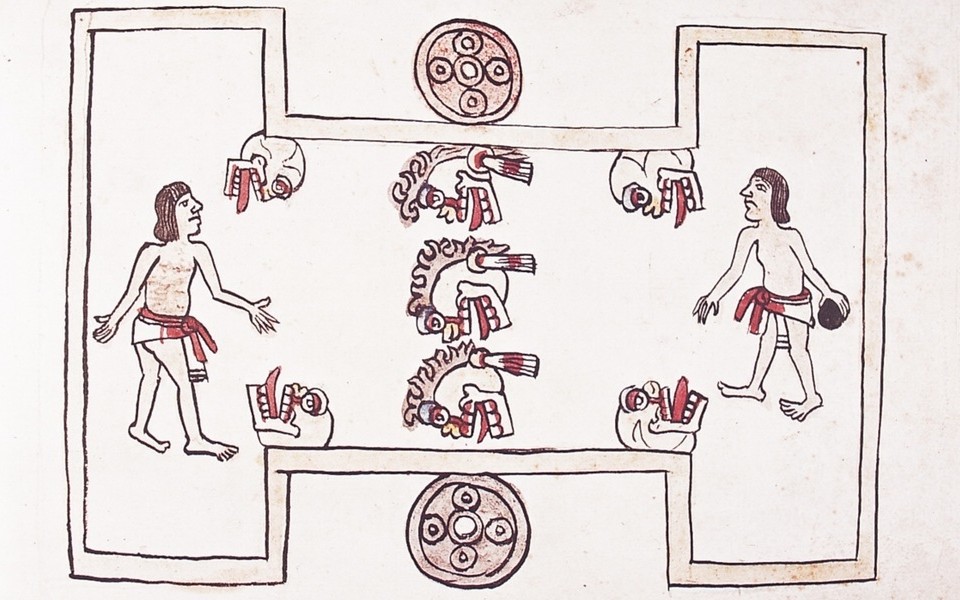
Matches took place on generally elongated courts, often recognisable by their capital I shape. Two parallel walls, either vertical or sloping, bordered the playing area and allowed the ball to bounce off them. Some courts also featured carved markers or paintings.
In certain variations, getting the ball through a stone ring was a remarkable feat. However, not all courts were equipped with rings. The number of players and scoring systems could also vary. Archaeologists still do not know all the details of how the matches were played.
A sport, but also a religious ritual
The juego de pelota extended far beyond entertainment. Matches could involve betting or play a role in the political life of cities. Ballcourts often occupied a prominent position in ceremonial centres, close to temples and palaces.
For several Mesoamerican civilisations, the movement of the ball evoked that of celestial bodies. The game could represent the struggle between day and night, light and darkness, life and death.
The Popol Vuh, the great mythological narrative of the K’iche’ Maya, tells the story of the twins Hunahpú and Ixbalanqué, who challenge the lords of the underworld to a ballgame before defeating them. This episode illustrates the importance of the game in Maya beliefs.
And what about human sacrifices? They did indeed occur in certain ritual contexts associated with the game. At Chichén Itzá, some bas-reliefs depict scenes of decapitation. However, contrary to a widespread belief, there is no evidence that the losing or winning teams were systematically sacrificed.
The great ballcourts of Mexico and Central America
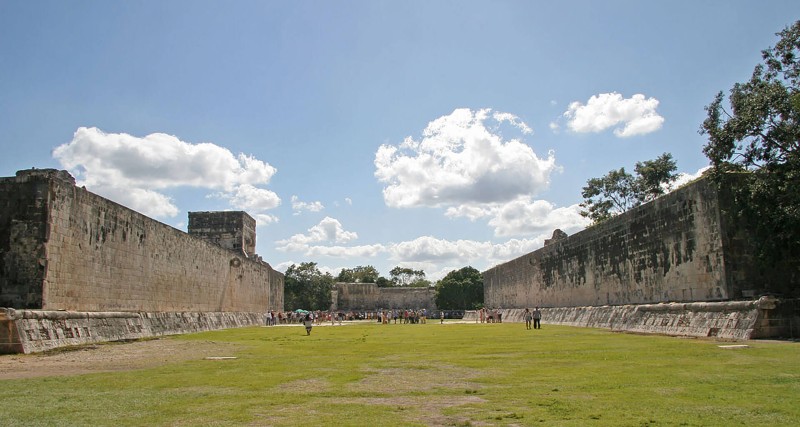
To discover the remains of the juego de pelota, Chichén Itzá, in Yucatán, remains one of the most impressive sites. Its Great Ballcourt, the largest known in Mesoamerica, gives an idea of the scale these structures could reach.
At El Tajín, in Veracruz, archaeologists have identified 17 ballcourts, several of which preserve particularly interesting sculptures. Cantona, in the state of Puebla, has 27 courts of widely varying dimensions.
In Guatemala, ballcourts can still be seen at Tikal and in other ancient Maya cities. In Honduras, the archaeological site of Copán preserves one of the best-known examples, with its stone markers carved in the shape of macaw heads.
From ulama to modern championships
The Spanish conquest profoundly disrupted Mesoamerican societies and led to the decline of many ancient practices. The juego de pelota disappeared from several regions, but some communities continued to pass it down.
This is particularly true in Sinaloa, in northwestern Mexico, where ulama is still played today. This tradition has been passed down from generation to generation despite changes in Mexican society.
At the same time, sports and cultural associations have revived other forms of the Mesoamerican ballgame, with rules adapted to modern competitions.
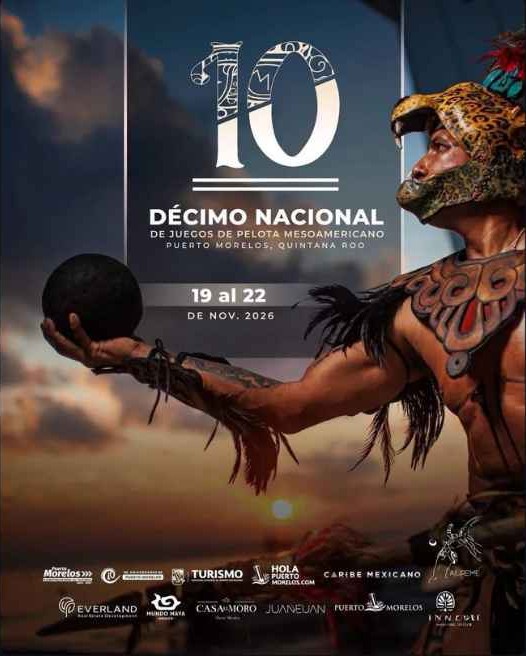
From 19 to 22 November 2026, Puerto Morelos, in Quintana Roo, hosted the tenth National Mesoamerican Ballgame Championship. Delegations from Mexico, Belize, Guatemala and El Salvador took part in the event, which featured men’s, women’s and international competitions.
Long before the arrival of football, Mesoamerican peoples were already passionate about a ballgame that brought together players, spectators and sometimes entire cities. Although the two sports have very different histories, this tradition is a reminder that major sporting events played an important role in the lives of these pre-Columbian societies.
Photos & illustration: Herbert Herget | Museo de Antropología de Mexico | Visit Yucatan | INAH