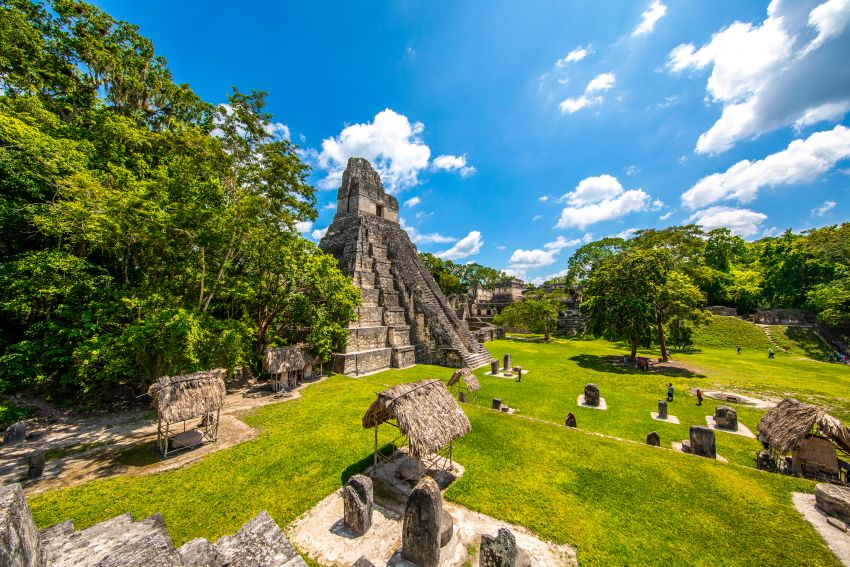
In Tikal National Park, everything does not begin at the foot of the temples. An essential part of archaeological work takes place away from visitors’ view. It is in the Conservation and Research Center that discovered objects are cleaned, stabilized, and studied, sometimes over several years.
Long reserved for researchers and specialists, this space has been open to the public since March 2026. Led by the Guatemalan government, with technical support from Mexico and Japan, this reopening marks a shift in how one of Mesoamerica’s most important sites can be experienced.
Seeing the work in progress, not only the results
Listed as a UNESCO World Heritage Site since 1979, Tikal is no longer limited to visiting its temples and monumental structures. The Conservation and Research Center, located inside the park, now allows access to spaces where remains are actively being processed.
The visit is not like a traditional museum experience. Visitors move through rooms where newly unearthed discoveries are sorted, fragments are studied, and objects are prepared for conservation.
The materials observed cover a period ranging from around 300 BC to the Classic Maya period (around 900 AD), offering a broader historical understanding of the occupation of Petén. This immersive approach provides a more concrete reading of archaeological work, usually invisible at open sites.
The center is accessible with the park entrance ticket from Monday to Friday, from 8:00 a.m. to 4:00 p.m., with no additional fee.
You may also like: El Petén jungle has covered the Mayan culture in Guatemala
A key international cooperation
The reopening of the center is based on collaboration between Guatemala, Mexico, and Japan.
Mexico’s National Institute of Anthropology and History provided expertise in restoration, while the Japan International Cooperation Agency contributed equipment and training. This cooperation has strengthened local capacities and introduced working methods aligned with international standards.
A gradual evolution of archaeological sites
Opening these spaces to the public is part of a broader trend already visible at some sites in Latin America, although formats vary.
At Teotihuacán (Mexico), objects from excavations are displayed in the site museum, placed in context but without showing restoration stages. At Copán (Honduras), original sculptures were moved to a museum for protection, while replicas remain on site. At Huaca Pucllana in Lima, ongoing excavations can be seen, but only in limited areas.
Tikal proposes a different approach: it is not only about presenting objects, but about showing work in progress. A way of expanding the visit and making it more complete, without directly intervening in the site’s structures.
Making conservation work visible helps visitors better understand what happens to an object after its discovery and offers another way of reading the site. It also opens perspectives for audiences interested in archaeology, history, or applied sciences in cultural tourism, and perhaps even inspires future vocations among young travelers.
Photo: INGUAT