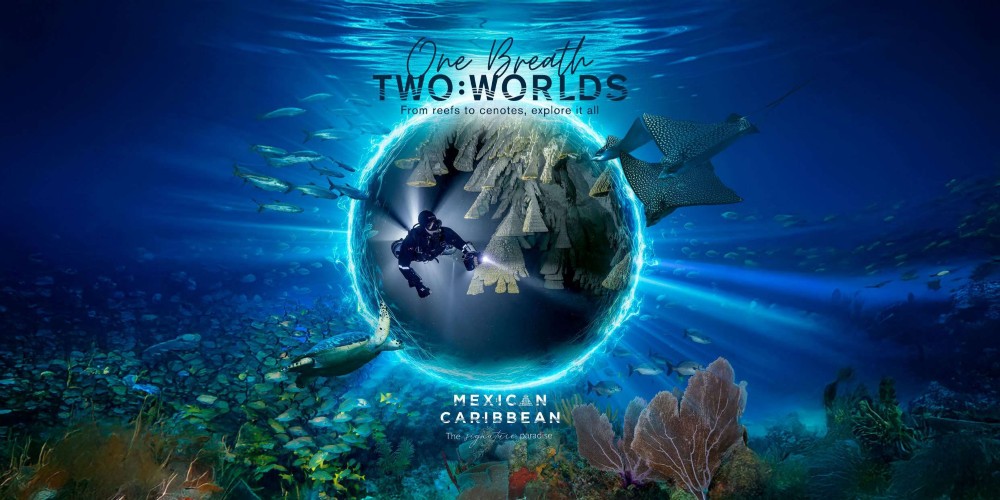
In a state that welcomes around 20 million visitors each year, more than 500,000 arrive with a specific objective: to dive. In this context, the government of Quintana Roo has launched the Mexican Caribbean Diving Guide, a tool designed to organize, structure, and enhance one of the destination’s most specialized — and most profitable — segments. The stated ambition is clear: to strengthen the positioning of the Mexican Caribbean as an international benchmark for underwater tourism, beyond the traditional sun-and-beach image.
The publication highlights the state’s marine wealth and its vast cenote systems, while aligning with a broader strategy: diversifying the offer, encouraging longer stays, and increasing economic benefits for local territories.
A tool to plan the underwater experience
During the presentation, Tourism Secretary Bernardo Cueto Riestra emphasized that the guide was developed with the participation of diving pioneers, underwater photographers, and specialists based in Quintana Roo, in coordination with the State Tourism Promotion Council and hotel associations.
Available in print (initial run of 1,000 copies) and digital formats, the guide compiles technical and descriptive information to organize both sea and freshwater dives, taking into account certification levels and the specific features of each site.
The Mexican Caribbean: figures and ecosystems
Official data confirms the strategic weight of the segment. According to the State Tourism Secretariat, divers stay an average of 7.7 days in the region — longer than general leisure visitors — and typically travel in groups. The segment also shows a slight majority of international visitors (50.7%). In Cozumel, daily spending per diver can reach USD 365, generating significant impact on accommodation, transport, dining, and specialized services.
This positioning relies on exceptional natural assets. Quintana Roo forms part of the Mesoamerican Reef System, the second-largest coral barrier reef in the world. It is also home to major cenote and flooded cave networks — including Sac Actun, Ox Bel Ha, and Dos Ojos — offering remarkable visibility and conditions suited to both recreational divers and more technical profiles.
Our article: Top Diving Destinations in Latin America (Part 1) – (Part 2)
Seven destinations structured around distinct diving profiles
The guide groups seven areas, each responding to specific expectations:
- In Isla Mujeres, the Underwater Museum of Art (MUSA) and nearby reefs allow visitors to observe submerged sculptures and accessible biodiversity across different skill levels.
- Cancún combines natural reefs and accessible shipwrecks from the port, with turtles, rays, and schools of fish suitable for beginners and certified divers alike.
- Puerto Morelos, within the Puerto Morelos Reef National Park, stands out for its well-preserved reefs, home to diverse Caribbean species.
- Playa del Carmen combines freshwater cenote dives with offshore marine explorations, offering good visibility and abundant fauna.
- Cozumel, internationally recognized, features iconic coral walls such as Palancar Reef, underwater tunnels, and drift dives appreciated by experienced divers.
- Tulum connects marine diving with interconnected cenote systems, integrated into some of the world’s largest flooded cave complexes, particularly attractive for technical exploration.
- Finally, the Grand Costa Maya in the south of the state offers relatively preserved reefs, historic shipwrecks, and the Banco Chinchorro atoll, a favored destination for advanced divers.
Taken together, these sites create a genuine territorial map of diving, where each zone corresponds to a distinct ecosystem and level of specialization. Diving thus appears not as a complementary activity, but as a structured system within the state’s tourism offer.
The guide also includes best-practice recommendations, safety guidelines, and references to environmental regulations — a decisive factor in a context where the preservation of reefs and freshwater systems determines the long-term sustainability of the product.
Long associated with their beaches, the Mexican Caribbean now reminds visitors through this guide that its true depth is also found underwater. Reefs, cenotes, shipwrecks: diving is not a secondary activity here, but another way of reading the territory. The challenge will now be to preserve this richness while meeting increasingly demanding international demand.