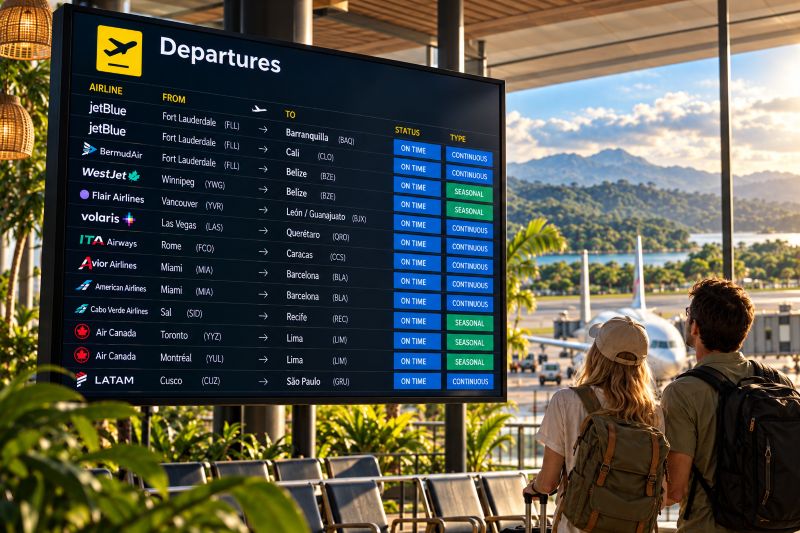
More than seven million international arrivals were recorded in Brazil between January and September 2026. Air arrivals reached a record level, while the Northeast posted the strongest regional growth and source markets continued to diversify.
Brazil recorded 4.9 million international arrivals by air during the first nine months of 2026, up 9.7% compared with the same period in 2025, according to Embratur. This is an unprecedented level for this mode of transport.
Across all points of entry, the country exceeded seven million foreign visitor arrivals, its second-best historical result for a nine-month period. Behind this national figure, two trends stand out: growing demand across most priority markets and particularly strong performances in several states in the Northeast.
Twenty priority markets on the rise

Of the 23 strategic markets monitored under Plano Brasis, the 2025-2027 international tourism marketing plan, twenty recorded an increase in arrivals.
The Chinese market stands out with a 78% increase in arrivals during the first nine months of the year. In September alone, the figure rose by 106% compared with the same month in 2025, reaching 22,496.
In the Americas, several source markets posted their best results for this period: Colombia (+25.5%), Mexico (+22.8%), Peru (+16.6%) and Canada (+13.5%).
To support Latin American demand, Embratur recently rolled out the “El país que te completa” campaign, presented during FIT América Latina in Buenos Aires. Targeting eight markets in the region, it combines content focused on travel experiences with commercial support involving airlines, travel agencies and tour operators.
The Northeast leads regional growth

With a 27.1% increase in international arrivals, the Northeast recorded the strongest growth among Brazil’s regions. The Southeast, which includes São Paulo and Rio de Janeiro, grew by 7.7%.
In the air segment, Rio Grande do Norte stands out with an increase of 124.6%. Alagoas (+88.1%) and Pernambuco (+65.2%) follow, while Paraíba (+49.8%) and Ceará (+23.2%) also contributed to this growth.
In total, eleven states reached record levels of international arrivals during the first nine months of 2026. For travel agencies and tour operators, this distribution provides useful indicators for refining their programmes, by comparing changes in visitor flows with available air services and local tourism supply.
Tourism revenue also reaches a new high
Spending by foreign visitors reflects these results. According to Central Bank data reported by Embratur, it totalled US$8.3 billion between January and September, representing a 9.1% year-on-year increase and a record for the period.
September contributed US$904.7 million in revenue, up 8.33% compared with the same month in 2025. This was also the highest amount ever recorded for a September.
Bruno Reis, president of Embratur, attributes the increase in average spending to the diversification of visitor profiles targeted under Plano Brasis. Beyond accommodation, the economic impact also extends to restaurants, excursions, guides and businesses in the destinations visited.
For tourism professionals, the challenge also lies in adapting products to these different profiles. The tourism trends report presented in April by Embratur, the Ministry of Tourism and Braztoa specifically highlighted the need to turn traveller expectations into marketable experiences, taking into account booking habits and spending patterns.
Photos: Embratur | Yago Prado