From Mexico to Uruguay, via Nicaragua and Brazil, here are seven celebrations that each reveal a different facet of Latin American culture. Behind these sometimes surprising customs lie stories, beliefs and forms of know-how passed down through several generations.
1. Noche de Rábanos: when radishes become sculptures in Mexico
Oaxaca, Mexico | 23 December
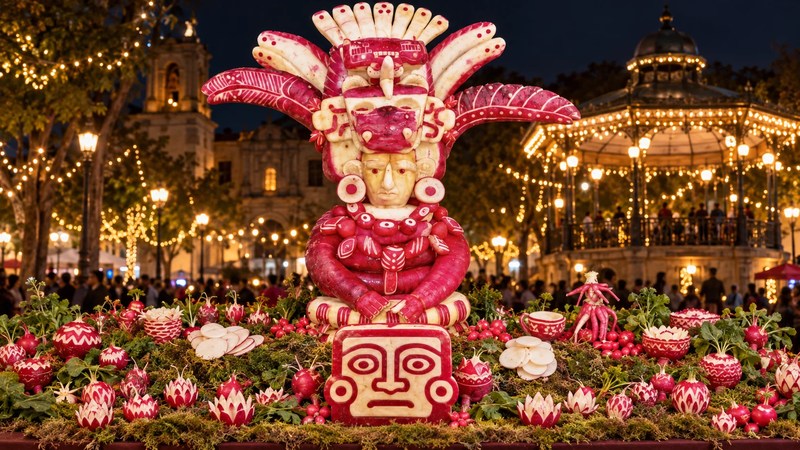
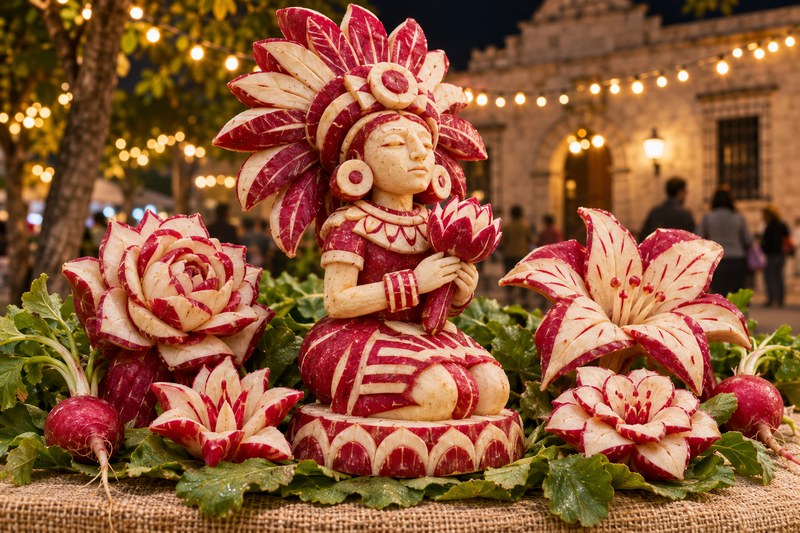
Every year, as Christmas approaches, the city of Oaxaca holds a rather unusual competition: artisans present sculptures made from radishes. Displayed around the Zócalo, the central square, the creations depict characters, monuments, traditional dances and scenes from everyday life.
The custom dates back to the late 19th century, when market gardeners decorated their stalls with carved radishes to attract customers. The initiative gradually grew, and the first official competition was held in 1897.
Today, participants use radishes grown especially for the occasion, whose size makes it possible to create elaborate compositions. The competition also includes categories dedicated to totomoxtle, the dried leaves surrounding ears of corn, and flor inmortal, a flower used in local crafts. An original Christmas tradition that continues to mobilise artisans from the region.
2. Guatemala’s giant kites: messages sent to ancestors
Sumpango and Santiago Sacatepéquez, Guatemala | 1 November
Every 1 November, enormous kites decorated with multicoloured motifs appear in Sumpango and Santiago Sacatepéquez, two towns located near Guatemala City. Some exceed ten metres in diameter and require several months of preparation.
In these Maya-Kaqchikel communities, the barriletes gigantes accompany All Saints’ Day celebrations and symbolise the link between the living and their ancestors. According to local beliefs, they make it possible to send messages to loved ones who have passed away.
Groups of barrileteros build the bamboo structures before covering them with coloured paper. The largest kites are displayed vertically, while smaller models can take flight. In Santiago Sacatepéquez, the ceremonies take place mainly around the cemetery, while in Sumpango the monumental creations are presented on a nearby field.
In 2024, UNESCO inscribed the techniques for making these kites on the Representative List of the Intangible Cultural Heritage of Humanity, recognising a form of know-how passed down within the communities.
Our article: All Saints’ Day in Guatemala: the flight of the giant kites
3. Alasitas: buying your dreams in miniature in Bolivia
La Paz, Bolivia | From 24 January
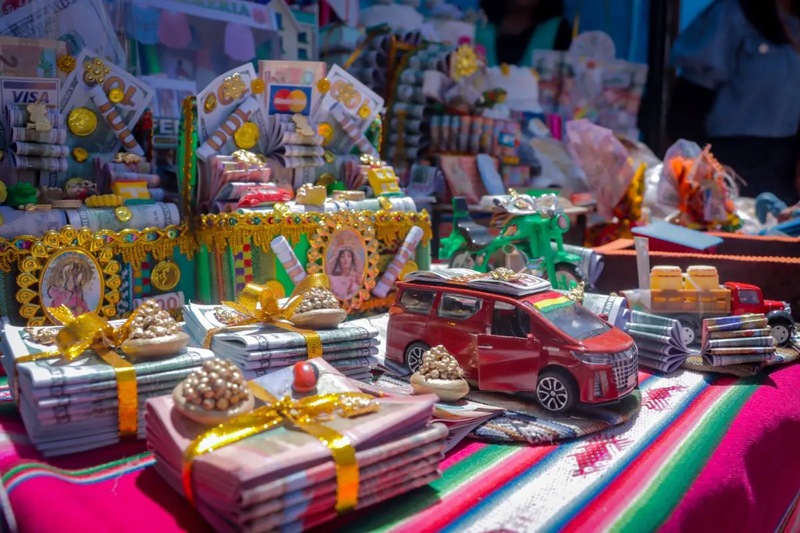
A house, a car, a university degree, a suitcase or even a small business: in La Paz, all of these can be bought in miniature. Every year, the Alasitas festival brings together thousands of people who come to buy miniature versions of the possessions or achievements they hope to obtain.
This tradition is associated with the Ekeko, a figure of prosperity and abundance in Andean beliefs, generally represented as a small man loaded with food, banknotes and everyday objects.
The miniatures are then blessed by Catholic priests or consecrated by specialists in Andean rituals, particularly yatiris. This combination of religious practices reflects the coexistence of different beliefs within Bolivian society.
In 2017, UNESCO inscribed the ritual journeys associated with Alasita on the Intangible Cultural Heritage of Humanity list. The festival continues to evolve with people’s aspirations, but the principle remains the same: giving concrete form to one’s wishes.
4. Parintins Festival: two rival bulls in a monumental competition in Brazil
Parintins, Amazonas, Brazil | Last weekend of June
In Parintins, a city located on an island in the Amazon River, two groups compete for victory every year in a spectacular contest: Boi Garantido, associated with the colour red, and Boi Caprichoso, recognisable by its blue colour.
For three nights, the two teams face each other in the Bumbódromo, an arena built especially for the festival. Each presents a show combining songs, dances, costumes and enormous moving sets, which sometimes transform during the performances.
The competition has its origins in boi-bumbá, a form of Brazilian popular theatre inspired by the story of an ox that dies before coming back to life. In Parintins, this tradition has incorporated Amazonian stories and references to Indigenous cultures. The performances are judged according to several artistic criteria, and supporters of each side actively take part in all three evenings.
Now one of the main cultural events in Amazonas, the festival attracts thousands of visitors every year to this city, which is mainly accessible by river or air.
5. Parrandas de Remedios: a neighbourhood rivalry that has lasted for two centuries in Cuba
Remedios, Cuba | 24 December
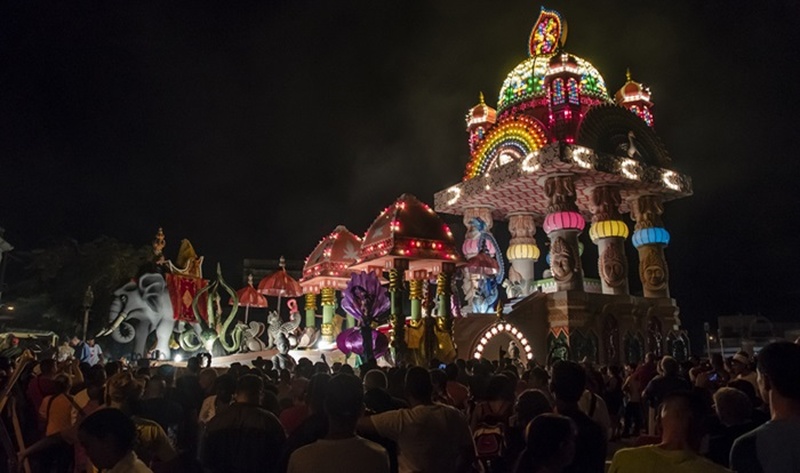
In Remedios, in the province of Villa Clara, Christmas celebrations take an unusual turn. On 24 December, two historic neighbourhoods, San Salvador and El Carmen, compete with decorated floats, illuminations and fireworks.
The origins of the festival date back to 1820. According to local history, a priest encouraged young people to walk through the streets making noise in order to wake residents and encourage them to attend Christmas religious celebrations. This practice is said to have gradually developed into a competition between neighbourhoods.
Today, each side prepares its floats and monumental decorations for several months, in the greatest secrecy. On Christmas Eve, the creations are revealed to the public, accompanied by music and pyrotechnic displays. Attempts at spying between the two teams are even part of the anecdotes surrounding this rivalry.
The tradition spread to several towns in central Cuba. In 2018, UNESCO inscribed the Parrandas of the country’s central region on the Intangible Cultural Heritage of Humanity list, recognising a practice now present in eighteen communities.
6. Noche de la Nostalgia: the night when all of Uruguay dances to yesterday’s hits
Uruguay | 24 August

On 24 August, Uruguay celebrates a festival with neither religious origins nor a traditional parade. Instead, nightclubs, restaurants and event venues organise evenings dedicated to the greatest hits of past decades. This is the Noche de la Nostalgia, which has become one of the country’s most popular nights of the year.
It all began in 1978, when a young radio presenter, Pablo Lecueder, organised an evening around the songs played on his programme Old Hits. The event was an immediate success, and the concept gradually spread throughout the country. The date is particularly well chosen, as the following day Uruguay celebrates its Declaration of Independence and is a public holiday.
Initially dedicated to music from the 1960s and 1970s, the playlists later expanded to include hits from subsequent decades. Disco, pop, rock and Latin American music now all share the dance floor.
The celebration also attracts visitors from neighbouring countries, particularly Argentina. In 2004, a national law recognised the Noche de la Nostalgia as an event of tourism interest.
7. Los Agüizotes: creatures from Nicaraguan legends invade Masaya
Masaya, Nicaragua | Last Friday of October
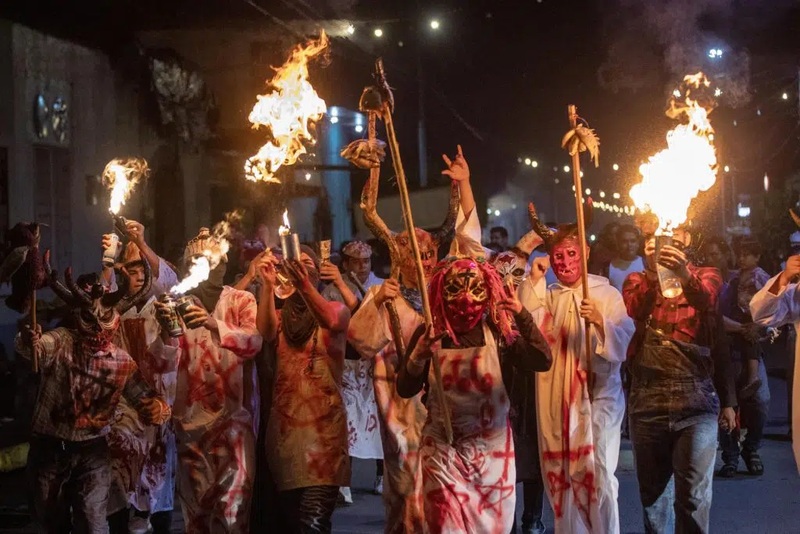
At nightfall, unsettling characters take over the streets of Masaya. Distorted masks, fantastical creatures, ghosts and figures drawn from Nicaraguan folk stories gather for the Agüizotes procession, held on the last Friday of every October.
First appearing in its current form in 1976, the celebration has its roots in the Monimbó neighbourhood and forms part of the festivities associated with San Jerónimo, the patron saint of Masaya.
The characters embody creatures from local legends: the Cegua, a woman capable of taking on a terrifying appearance; the Mocuana; the Cadejo, a mysterious animal often represented as a dog; and the Padre sin Cabeza, a headless priest. Participants move through the streets in costumes and masks, carrying traditional lamps known as candiles, accompanied by musicians.
Although it takes place around the same time as Halloween, the celebration has its own cultural references, rooted in Nicaraguan beliefs and oral tradition. In 2026, the procession celebrated its fiftieth anniversary.
Photos : Gobierno del Estado de Oaxaca | EFE | D.R. | La Razon