
Located in Mexico’s Yucatan state, 80 kilometers from Merida and Campeche, the ancient city of Uxmal is a masterpiece of Mayan architecture. Less well known than other sites such as Chichen Itza, Uxmal nevertheless offers an experience just as rich in history, culture and mystery.
History and significance
Uxmal, which means “thrice built” in the Mayan language, was built from the 4th century BC onwards, becoming an important center of Mayan civilization and reaching its apogee between the 6th and 10th centuries. The city is renowned for its sophisticated architecture and intricately detailed buildings, testifying to a society that was both mystical and ingenious. Uxmal was a major religious, economic and political center of the Puuc region, famous for its distinct architectural style.
Architectural masterpieces
The buildings at Uxmal are outstanding examples of Puuc architecture, characterized by elaborate facades of carved stone and geometric friezes. Among the site’s most important monuments:
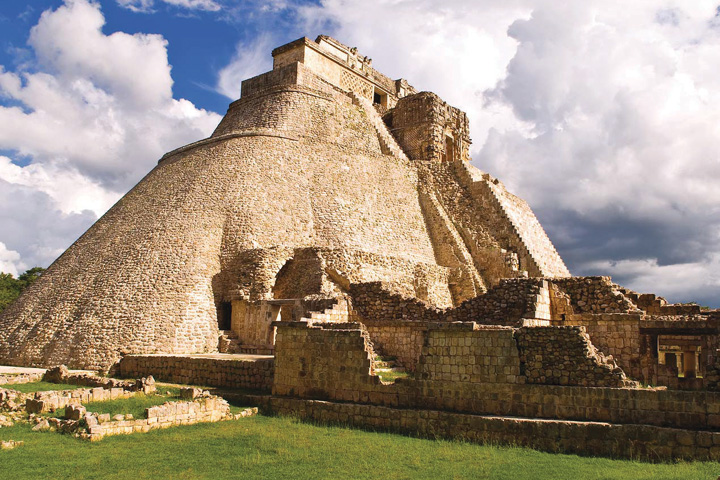
- The Pyramid of the Magician or the Adivino, also known as the “Pyramid of the Dwarf”, is one of Uxmal’s most emblematic structures. Unique in its kind with its oval shape and five levels, it rises to a height of almost 40 metres. According to legend, it was built by a dwarf in a single night. The pyramid is a remarkable example of Mayan architectural ingenuity and dominates the Uxmal landscape.

- The Governor’s Palace is considered one of the finest examples of Mayan architecture. Situated on an elevated platform, this vast edifice is famous for its long façade adorned with geometric motifs and sculptures representing ancestral divinities. Its precise astronomical alignment with the cardinal points testifies to the advancement of Mayan astronomical knowledge.
- The Nunnery Quadrangle is a complex of buildings arranged around a central courtyard. Each building is adorned with detailed friezes and sculptures, depicting masks of Chaac, the god of rain, as well as other religious and mythological motifs. The complex’s name derives from a supposed resemblance to a European convent, although its original use was probably ceremonial.
- The House of the Turtles is a small temple so named because of the turtle sculptures that adorn its cornice. Turtles were an important symbol for the Maya, associated with rain and water. Although smaller than other structures in Uxmal, this building stands out for its elegance and artistic detail.

- Another important feature of the site is the ball court, where a ritual game crucial to Mayan culture was played. Players had to pass a ball through stone rings fixed high up on the sides of the field, a task requiring both skill and strength.
Preservation and research
A UNESCO World Heritage Site, Uxmal is the subject of ongoing archaeological research and conservation efforts. This work is crucial to preserving the integrity of this historic site and continuing to uncover the secrets of Mayan civilization.
Tips for travellers
To get the most out of your visit to Uxmal, it’s advisable to wear comfortable shoes and be prepared for the hot, humid weather typical of the Yucatan. Visiting early in the morning or late in the afternoon may offer a more pleasant experience.
Uxmal is a fascinating destination for anyone interested in Mayan history, archaeology, culture and cosmology. Its magnificent buildings and mystical atmosphere make it a must for discovering a lesser-known but equally captivating aspect of one of history’s greatest civilizations.