
Some pieces of jewelry owe less to the value of the metal than to the craftsmanship, mastery, and time they require. In Santa Cruz de Mompox, in the Bolívar department of Colombia, about 200 kilometers southeast of Cartagena — roughly a 4 to 5-hour drive — this takes the form of nearly imperceptible gold threads that, patiently intertwined, give rise to one of the most refined goldsmithing traditions in Latin America. A well-preserved colonial town, Mompox has made this craft one of its defining skills. More than a technique, it is a practice embedded in local history, economy, and everyday life.
A craft introduced during the colonial period and rooted locally
Filigree did not originate in the Colombian Caribbean. Its traces date back to Antiquity in the Middle East and Egypt, where finely worked gold threads already adorned objects and jewelry. The technique later developed across the Mediterranean world, particularly during the Roman era, before spreading throughout Europe in the Middle Ages. In Italy and later in Spain, it became prominent in religious objects and ornaments, with increasingly elaborate motifs. Through this transmission — notably influenced by Andalusian traditions and Arab heritage — filigree reached the Americas during the colonial period.
In South America, Mompox offered favorable conditions: access to gold and a strategic position along the Magdalena River, then a major trade route in New Granada, which facilitated its diffusion and development.
Between the 17th and 18th centuries, goldsmithing became a central activity, driven by religious commissions and those of colonial elites — landowners, influential families, and merchants — who contributed to its expansion. The craft was passed down within these circles, a continuity still visible today in workshops set up in inherited houses.
While this technique is also found in other parts of Latin America — notably in Oaxaca, Mexico, and Catacaos, Peru — Mompox stands out for its distinctive motifs and working methods.
A technique of extreme precision
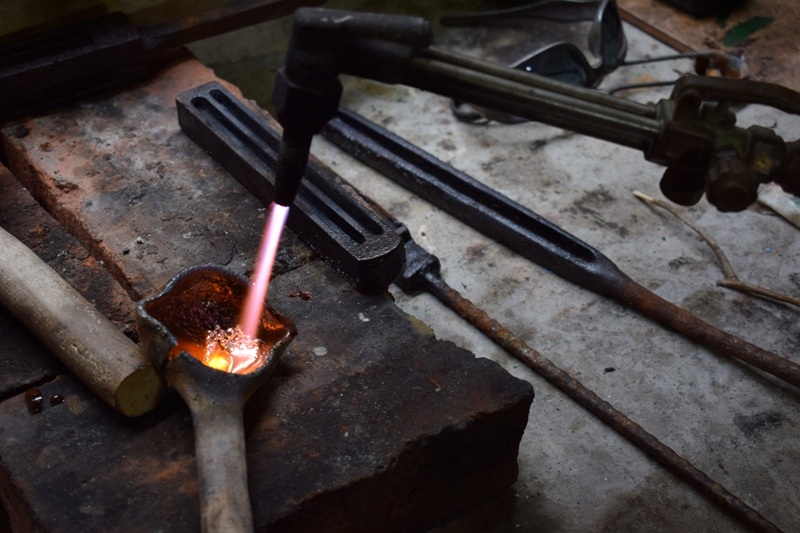
Filigree is based on a simple yet highly demanding principle: transforming metals such as gold or silver into extremely fine threads, then intertwining them to form complex structures. The process begins with melting the metal into small bars, which are repeatedly stretched until they reach a thickness of less than a millimeter.
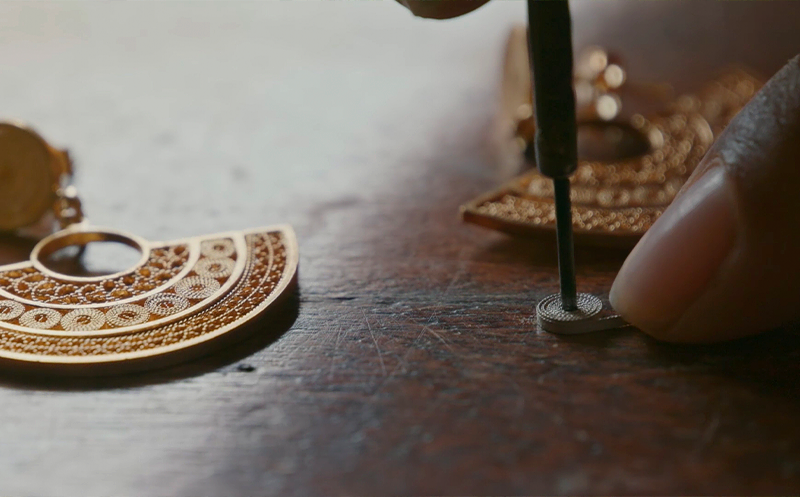
Each thread is then coiled, braided, or shaped into motifs assembled onto a base. Everything is done by hand. While some tools have evolved — particularly for stretching, with the use of rolling mills and drawplates — the final assembly still depends entirely on the artisan’s gesture.
Production time varies considerably: a simple piece may take a day, while more complex creations, incorporating different types of braiding and a high density of detail, can require weeks of work.
Motifs inspired by the surrounding environment
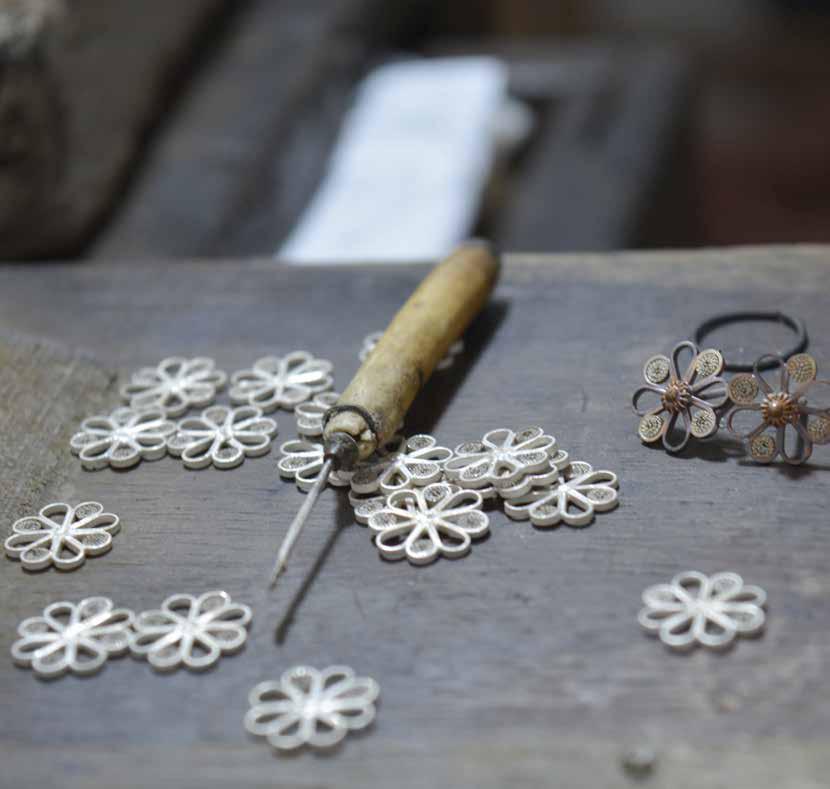
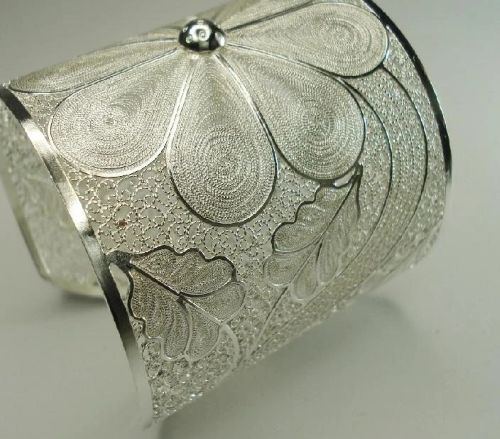
The motifs draw heavily from the immediate environment: flowers, leaves, butterflies, and organic forms reminiscent of the river landscape. These are combined with geometric patterns inherited from Hispano-Arab traditions, recognizable in interlacing and repetitive structures.
Each piece is built on a fine framework, then patiently filled with even more delicate threads, coiled, twisted, or spiraled. This nearly invisible filling work creates variations in density and transparency, giving the material a distinctive lightness where empty space is as important as the thread itself.
Depending on the workshops and transmitted techniques, combinations vary: tight spirals, undulating lines, stylized vegetal forms. Nothing is entirely fixed, and it is often in these subtle variations that the artisan’s hand can be recognized.
An experience in itself
In Mompox, beyond purchasing pieces as souvenirs or gifts, some workshops can be visited, offering insight into the different stages of production. It is also possible to try working with filigree and create simple motifs or jewelry.
Another notable aspect is that many workshops are located directly within artisans’ homes. This proximity to their living space provides a deeper understanding of their daily work and allows direct interaction with those who have inherited this craft across generations. For further insight, places such as Casa Museo Luis Guillermo Trespalacios trace the evolution of techniques through tools, methods, and collections reflecting their transformation over time.
Beyond its material value, each piece reflects a craftsmanship that escapes standardization. Filigree displays subtle variations: differences in thread thickness, density of braiding, or ways of resolving the same motif. No two pieces are identical, and once worn, they evoke the workshops, the artisans, and a tradition that remains very much alive.
You may also like: Journey along the Magdalena River: a unique river odyssey in Colombia
In Mompox, filigree is not simply an object to take away. It is part of a rhythm — that of a gesture repeated, learned, and refined over time. In each piece, what is visible matters as much as what escapes the eye: hours of work, trials, and variations from one workshop to another.
Observing this craft also means understanding another way of producing, where value lies as much in the process as in the result. In a world where everything tends to be replicated identically, this margin of difference — however small — is perhaps what makes all the difference.
Photos: Procolombia | Miguel Ángel Cortés | Luis Aldemar Rodríguez | Andrea Ramirez