
In southern Peru, in the Cusco region, a mountain with spectacular hues has recently caught the eye: Pallay Punchu de Apu T’aqllo. The site became known in 2020, when a geology student, Tony Ccalta, who had returned to his family during the lockdown, shared on social media images of a climb he made in search of medicinal plants. His photographs went viral, revealing to the wider public a landscape previously familiar only to the inhabitants of Layo, and opening a new chapter in Andean tourism.
A landscape shaped by minerals
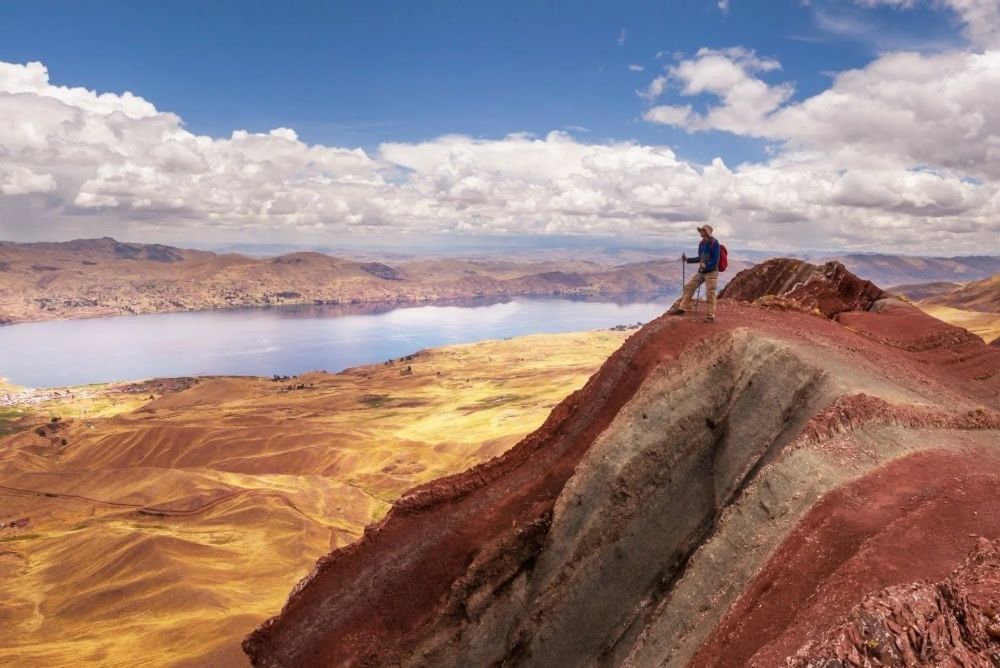
Nicknamed the “third rainbow mountain of Peru,” Pallay Punchu rises to around 4,700 meters above sea level. Its spectacular palette of colors comes from the mineral composition of the soil: layers of clay, sandstone, limonite, and marl, tracing parallel red, green, pink, and ocher lines across its slopes.
The name Pallay Punchu, of Quechua origin, means “decorated poncho,” a reference to the geometry of its strata, reminiscent of the woven patterns of traditional Andean textiles.
Access and route
Access begins in Cusco, followed by a five-hour drive to the district of Layo. The hike then starts toward the Apu Taqllo Apacheta hill. The ascent, covering 8 to 10 kilometers, takes between two and four hours depending on the level of acclimatization.
The trail poses no major technical difficulty, but the altitude and slope require good physical condition and prior acclimatization.
Our article: Cusco: Peru’s Imperial City
From the summit, the view opens onto Lake Langui Layo, a vast high-altitude mirror located at nearly 4,000 meters. Its peaceful waters are home to communities that live from artisanal fishing and trout farming. The site makes an ideal stop either before or after the climb.
The best time to visit is from May to October, when clear skies enhance the mountain’s natural tones.
Tourism in development
Unlike Vinicunca and Palccoyo, the two other “rainbow mountains” already known on the Andean circuit, Pallay Punchu still has a tourist infrastructure in development. Local authorities are working to improve signage, trail safety, and environmental management, while preserving the serenity of the site and the delicate balance of its natural surroundings.
A symbol of a territory that continues to reinvent itself, Pallay Punchu highlights the richness of southern Peru and its ability to reveal landscapes still little known. Between spectacular geology and local initiative, this mountain embodies a new phase of Andean tourism — more diverse, more community-rooted, and more attentive to its environment.
Photos: PROMPERÚ