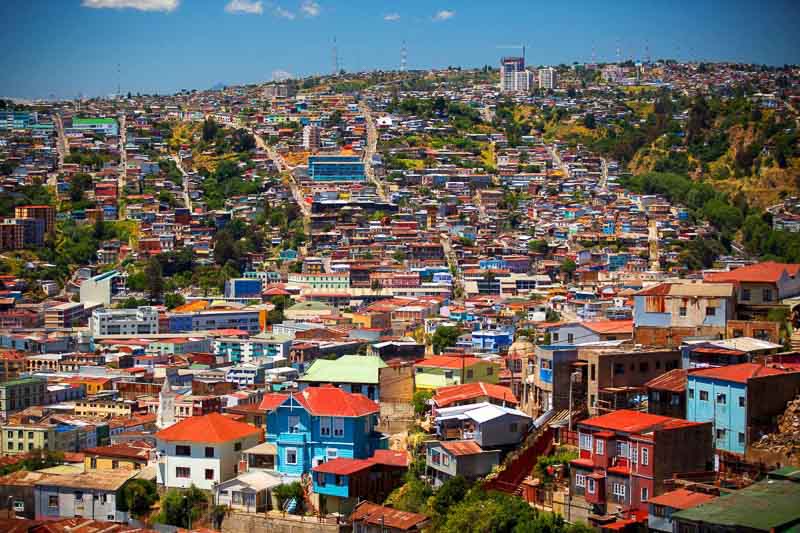

Less than two hours from Santiago de Chile, Valparaíso clings to the hills surrounding its bay facing the Pacific. From below, one can see the colorful houses climbing up the cerros, the stairways disappearing between façades and the old ascensores that still connect certain neighborhoods to the center. Yet it is with the port that one must begin in order to understand the city.
At the end of the 19th century, Valparaíso was one of the major merchant ports on the South American Pacific coast. Ships linking the Atlantic to the Pacific via the Strait of Magellan stopped there, bringing together sailors, traders and immigrants, particularly from Great Britain and Germany. The opening of the Panama Canal in 1914 disrupted this activity, but the city preserved much of the architecture and urban landscape shaped during that period. This heritage led UNESCO to inscribe its historic quarter on the World Heritage List in 2003.
Slopes and detours
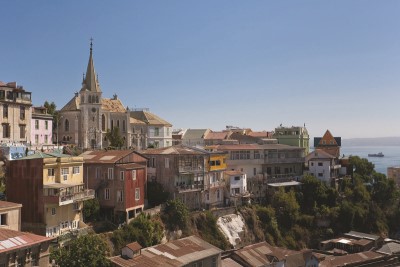
Valparaíso is divided between the plan, the lower and relatively flat part of the city, and the many hills rising around the bay. Climbing toward Cerro Alegre or Cerro Concepción means entering another Valparaíso, with its cobbled streets, narrow passages, endless stairways, small squares, houses with colorful façades and viewpoints that sometimes appear at the end of an alley.
The Paseos Gervasoni, Atkinson and Yugoslavo make it possible to gain a little height and look at the city differently. From Paseo Yugoslavo, above Plaza Sotomayor, the port cranes, boats and hills all come together in the same panorama. The Palacio Baburizza, which now houses the Museo Municipal de Bellas Artes, also recalls the European influence that marked these neighborhoods.
And then there are the ascensores. The oldest, Ascensor Concepción, dates back to 1883. Reina Victoria and El Peral are also among those that continue to accompany life in the city. In January 2026, seven were still operating, most of them used daily by residents.
Walls that never stay silent
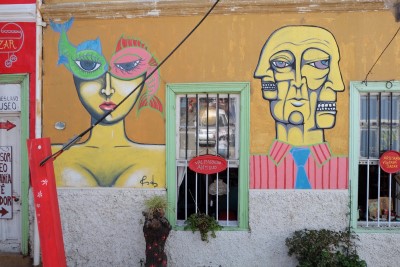
It is also impossible to speak about Valparaíso without mentioning its walls. Murals, graffiti, characters, animals, political scenes and abstract compositions appear on façades, stairways and sometimes even in the narrowest passages. Part of the pleasure lies precisely in walking without always looking for a specific work and coming across a painting around the corner.
On Cerro Bellavista, the Museo a Cielo Abierto tells part of this story. Inaugurated in 1992, it brings together twenty large murals linked to artists such as Roberto Matta, Nemesio Antúnez and Mario Carreño. The project extended an experiment that had begun in the late 1960s with students and artists from the Catholic University.
Street art has since extended far beyond this route. On Alegre, Concepción, Bellavista and other cerros, the walls continue to change. Some works remain for years, others disappear beneath new paint. That is also what gives Valparaíso its feeling of being a city never entirely finished.
From Muelle Prat to Cerro Cárcel
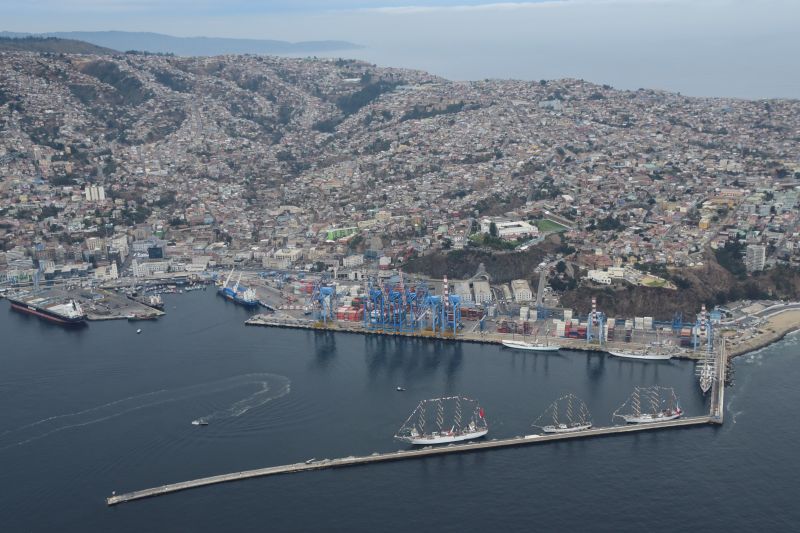
Coming back down toward the plan, Plaza Sotomayor immediately places the city back in its maritime history. The Armada building dominates the square and Muelle Prat is only a few steps away. Here, the port is not a setting inherited from the past: ships and port facilities continue to be part of daily life in the city.
Valparaíso has also managed to transform certain places without completely erasing what they once were. On Cerro Cárcel, the former public prison has become the Parque Cultural. The cells have given way to spaces for theater, dance, music and exhibitions, while from the outdoor areas the bay once again appears between the buildings.
Even public transport tells the story of the city. Trolleybuses have circulated in Valparaíso since 1952 and still cross El Almendral, the center and Barrio Puerto.
At Neruda’s house, Valparaíso through the window
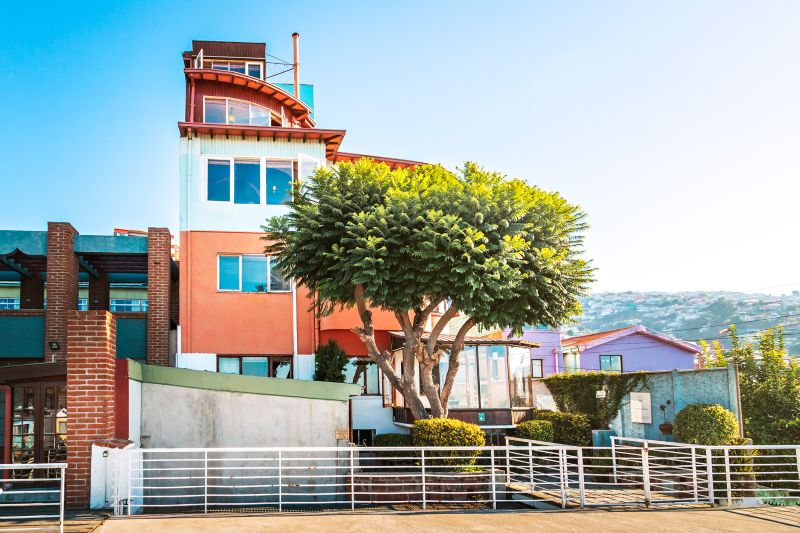
On the heights, La Sebastiana remains inseparable from Pablo Neruda. The poet was looking in Valparaíso for a house where he could write away from Santiago and look out at the sea. He settled in this building on Cerro Florida in 1961 and took part in its arrangement himself.
The house, declared a National Monument in 2011, resembles its owner: narrow, surprising, filled with objects, collections and details one does not necessarily expect. But above all, it is the windows that draw attention. The bay, the port and the houses on the hills unfold almost like a painting.
At the table, between the Pacific and chorrillana
The cuisine naturally bears the mark of the port. Fish, shellfish and seafood occupy an important place in restaurants along the coast and in more traditional picadas.
But Valparaíso also claims a much less maritime dish: chorrillana. French fries, meat, onions and eggs make up this generous plate, usually placed in the middle of the table and shared. Its exact origin is still the subject of several versions, but it is strongly associated with the city and especially with a restaurant that has become an institution: J. Cruz.
Only a few kilometers away, the seaside resort of Viña del Mar offers an almost immediate contrast. More orderly and more open, with its white sand beaches and wide avenues, it is also known for its Festival, held every year in February. Valparaíso and Viña del Mar thus offer two very different experiences, but they are particularly complementary for discovering this part of the Chilean coast.
Our article: From local contest to global icon: the history of the Viña del Mar Festival
Valparaíso is not a city one discovers by following a straight line. You climb, you descend, you stop in front of a house and wonder how it still manages to hold on to the slope. Sometimes you get a little lost, and that is often when the city becomes most interesting.
From sailors’ songs to poets, painters and musicians, the city has inspired generations of artists who found in its port, hills and streets an almost inexhaustible source of material. Colorful, steep and sometimes disorderly, Valparaíso does not really try to be perfect, and that is probably part of what makes it so endearing.
Photos: SERNATUR