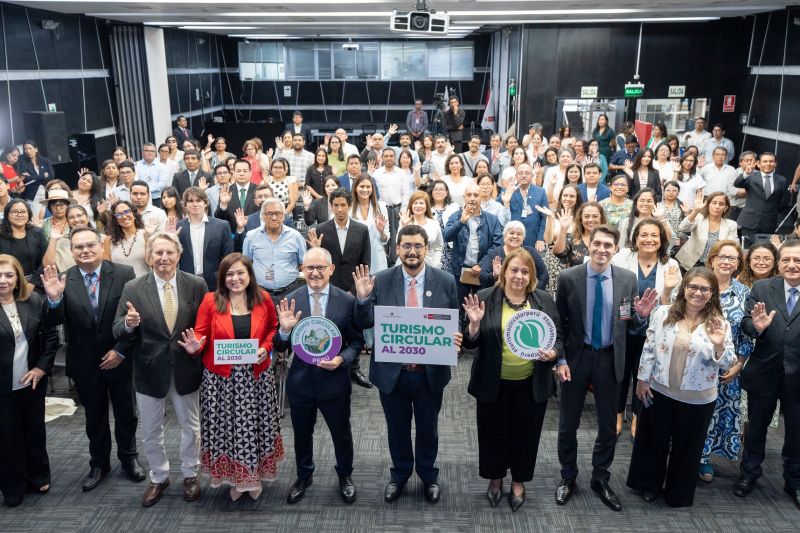
Peru is no longer just talking about sustainable tourism. With the presentation of its roadmap for a circular economy in the sector by 2030, the country is taking a step further and becoming the first in Latin America and the Caribbean to formalize an approach applied to tourism.
Behind this document, led by the Ministry of Foreign Trade and Tourism (MINCETUR), the idea is clear: make better use of resources, reduce waste, and ensure that economic benefits are more widely distributed across territories. The challenge now is to make these principles applicable in a sector where, until now, they have often remained theoretical.
A project built with the support of the European Union
The European Union has supported Peru both technically and financially through its circular economy program.
This support has helped structure the approach and accelerate work on topics that are still relatively new in tourism. It is part of a broader collaboration already underway between Peru and the European Union on economic transitions.
From the European perspective, this roadmap is seen as an important milestone. It reflects a shift from a general framework to concrete tools that can be used by stakeholders in the sector.
For industry professionals, this is precisely the key issue: having a clear framework, but above all one that can be implemented to evolve practices.
Concrete objectives for a topic that often remains theoretical
One of the most notable aspects of this roadmap lies in its expected outcomes. By 2030, authorities estimate that this transition could generate an additional contribution of around 2% to tourism GDP, while creating more than 31,000 jobs.
From an environmental perspective, the ambition is also measurable, with an estimated reduction of nearly 73,000 tonnes of CO₂ and the preservation of more than 2.16 million hectares of ecosystems and natural and cultural heritage.
These figures provide a clear sense of scale and help illustrate the concrete impact that a circular economy could have on tourism.
From framework to on-the-ground reality
Many initiatives already exist, but they often remain isolated. Some companies are taking action, and certain destinations are experimenting, but without real coordination between them. This is precisely what Peru aims to address.
The goal is to connect these efforts and give them coherence at the territorial level. Peruvian tourism relies on highly diverse natural and cultural resources across regions, which rules out any one-size-fits-all approach.
In practical terms, this means improving coordination between public authorities, businesses, and local communities, while further integrating local value chains. Resource management, waste reduction, and the promotion of local production must now be translated into operational practices.
In this context, the “Turismo Circular Perú” program, developed with CANATUR, supports professionals in implementing these measures on the ground.
This roadmap does not immediately transform the country’s tourism model. However, it does establish a framework, clear objectives, and practical tools.
What comes next will depend on its implementation in destinations and on the ability of stakeholders to take ownership of it. Only under these conditions will the circular economy move beyond strategy and become embedded in sector practices.
Photo: MINCETUR