Lagoons between dunes, a river carpeted in red and pink, or a desert bursting into flower… In Latin America, some landscapes change with the seasons. Certain migrations also create spectacles that last only a few months. To see them, choosing the destination is not enough: the trip also has to be planned for the right time.
1. In Brazil, discover the lagoons of Lençóis Maranhenses
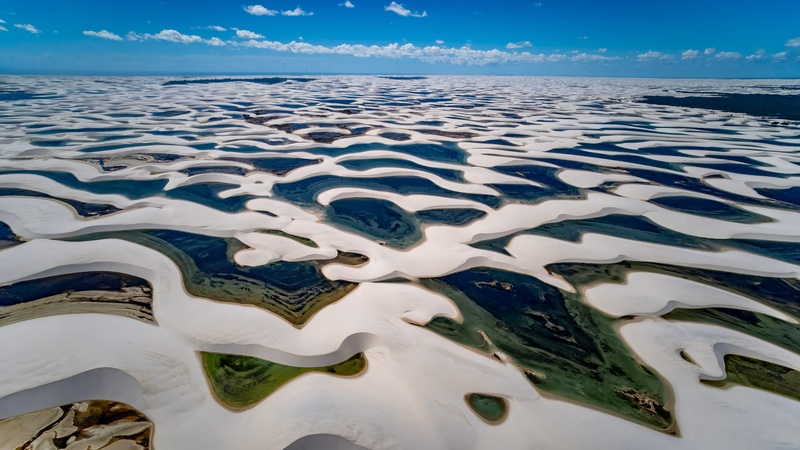
At first glance, Lençóis Maranhenses looks like an immense white-sand desert. Yet this region of Brazil’s Northeast receives significant rainfall during the first half of the year. Water collects between the dunes, forming freshwater lagoons in shades ranging from blue to green. From the top of the dunes, an almost unreal landscape appears: curves of pale sand dotted with pools where visitors can swim.
The scenery changes with the rainfall and the progression of the dry season. Some lagoons remain, while others shrink or disappear. From June to September, conditions are generally favourable for visiting, although water levels vary from year to year.
Located in the state of Maranhão, the region can be explored particularly from Barreirinhas and Santo Amaro. São Luís, the state capital, is the main gateway to the area. The destination has experienced strong tourism growth: visitor numbers increased by almost 38% between January and July 2025 compared with the same period in 2024.
You may also like: The Northeast via the Route of Emotions
2. In Colombia, the changing colours of Caño Cristales
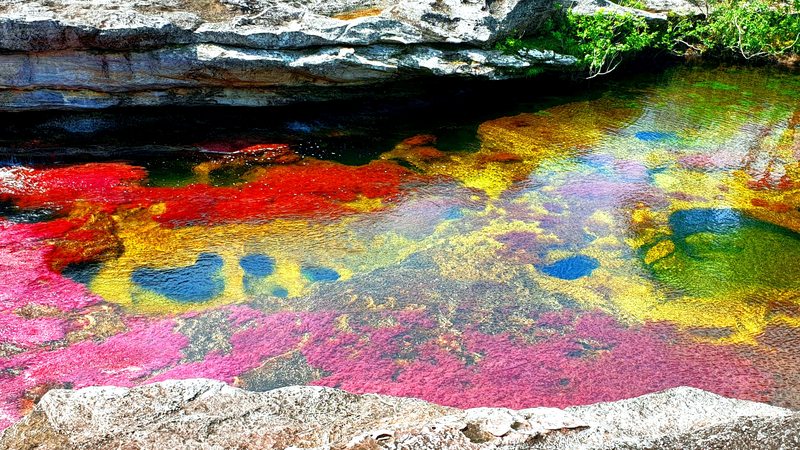
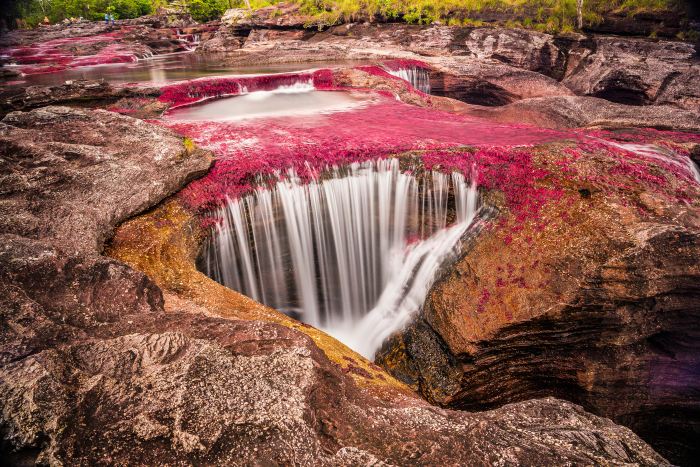
In the department of Meta, near La Macarena, around 280 kilometres south of Bogotá as the crow flies, the Caño Cristales river flows through a succession of waterfalls and natural pools. At certain times of year, its riverbed is mainly covered in red and pink, visible through the transparent water. These colours come from an aquatic plant known as Macarenia clavigera, which grows on submerged rocks.
Depending on the light and water level, the intensity of the colours varies. The river therefore changes appearance throughout the year. The best time to see its colours is generally between June and November, although conditions and opening dates should be checked with local tourism professionals.
As the site is remote and protected, visits are organised with authorised operators and local guides. Routes include walks of varying length and difficulty depending on the areas visited.
Find out more: Caño Cristales: Colombia’s Symphony of Colours
3. In Chile, the desert covered in flowers
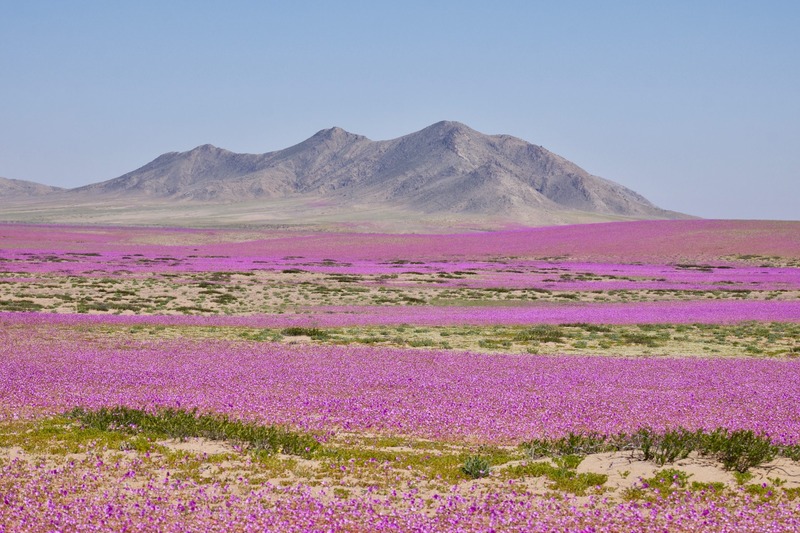
Beneath the soils of the Atacama Desert, seeds and bulbs can remain dormant for years. When rainfall brings enough moisture and conditions become favourable, vegetation awakens. Normally arid expanses are then covered in pink, yellow, white or purple flowers: this is the desierto florido, the flowering desert.
The phenomenon occurs particularly around Copiapó, Vallenar and Huasco, in the southern Atacama Desert. Flowering generally occurs between September and November, during the Southern Hemisphere spring. Its scale depends on rainfall and climatic conditions, and vast carpets of flowers do not appear every year.
This uncertainty also makes their appearance a welcome surprise for travellers. If you want to include the flowering desert in an itinerary, ask your operator whether blooms are expected or have already been observed. It remains a rare spectacle whose calendar is decided by nature.
4. In Mexico, forests filled with monarch butterflies
Every autumn, millions of monarch butterflies leave Canada and the northern United States for the mountains of central Mexico. These orange-and-black butterflies, measuring 7 to 10 centimetres across their wings, can travel nearly 5,000 kilometres to reach their winter refuges.
They spend the winter in the oyamel fir forests of Michoacán and the State of Mexico. There, they find conditions that allow them to shelter and conserve energy before heading north again in spring.
The spectacle depends on the weather. On cooler days, the monarchs remain clustered on trunks and branches, forming thick orange groups. When the sun warms the forest, some take flight and fill the woodland.
The visiting season generally runs from November to March, depending on sanctuary opening dates. El Rosario is among the sites where these gatherings can be observed.
5. In Costa Rica, watch turtles nesting
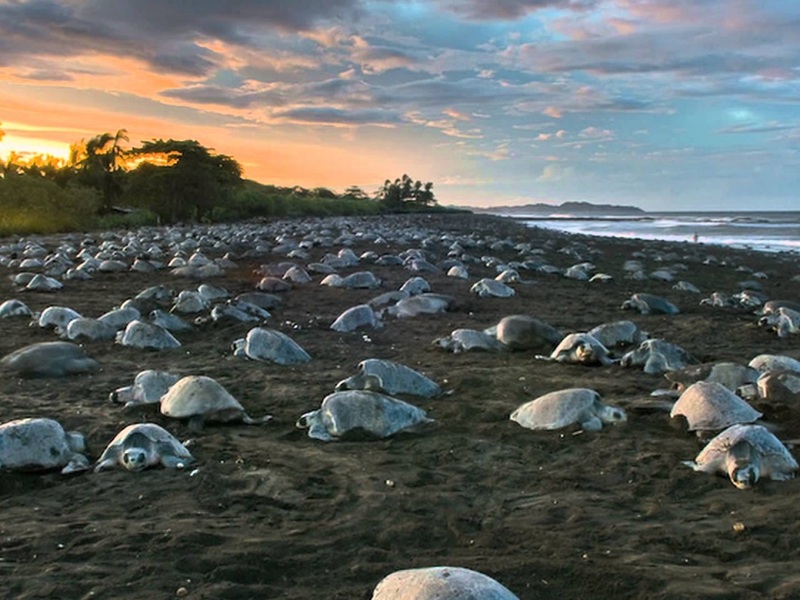
Emerging from the ocean, making their way up the beach, digging a nest, laying their eggs and then covering them with sand: turtle nesting follows a sequence of movements that can be observed on several beaches in Costa Rica.
At Ostional, on the Pacific coast, olive ridley turtles can arrive by the thousands during what are known as arribadas, mass nesting events concentrated over a few days. The largest gatherings generally occur between July and November, although their exact dates remain difficult to predict.
On the other side of the country, at Tortuguero on the Caribbean coast, the main nesting season for green turtles runs roughly from July to October. Night excursions are accompanied by guides who ensure that visitors do not disturb the animals. The two experiences are different: at Ostional, the spectacle comes from the mass arrival of turtles; at Tortuguero, from observing the nesting process in the darkness.
Other nesting sites can be found elsewhere in Latin America, particularly in Mexico, Panama and the Dominican Republic. Seasons and viewing opportunities vary according to the beaches and species.
6. In Bolivia, the immense mirror of Salar de Uyuni
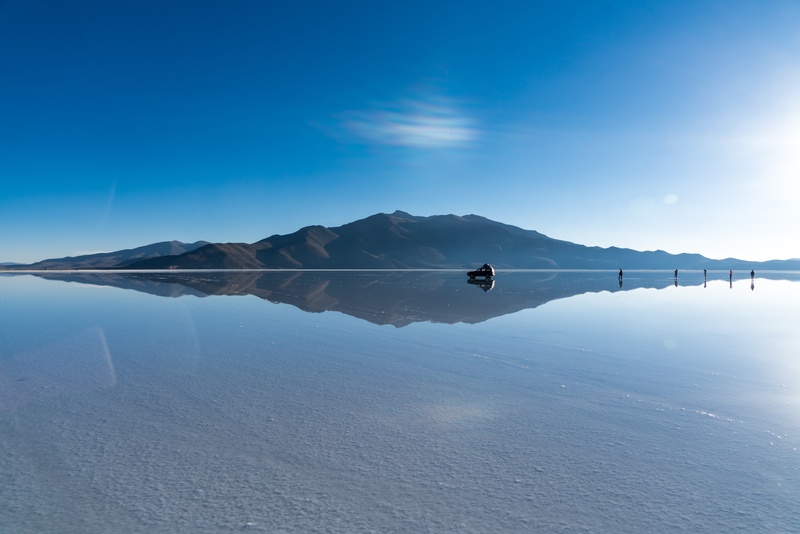
On the high plateau of southwestern Bolivia, Salar de Uyuni is the world’s largest salt flat. A remnant of ancient dried-up lakes, this immense white plain is usually seen beneath clear skies, with geometric patterns marking its surface.
During the rainy season, the landscape changes. A thin layer of water covers parts of the salt flat, reflecting the sky and clouds. When the water is calm, the horizon seems to disappear: visitors move through an immense mirror in which the sky appears to extend beneath their feet.
The best period is generally between December and March, although conditions vary from year to year. The presence of water alone is not enough: wind and surface conditions also affect the sharpness of the reflections.
The salar is explored by 4×4 on excursions with a driver-guide, along routes adapted to current conditions. The journey can continue towards South Lípez, through colourful lagoons, volcanoes and high-altitude landscapes. During periods of flooding, some areas become inaccessible, and itineraries are adjusted to make the most of the mirror effect wherever it forms.
Read our article: Salar of Uyuni: the mirror of the heavens
Photos: Visit Brasil | ProColombia | Sernatur | Visit Michoacan | Essential Costa Rica | Shutterstock