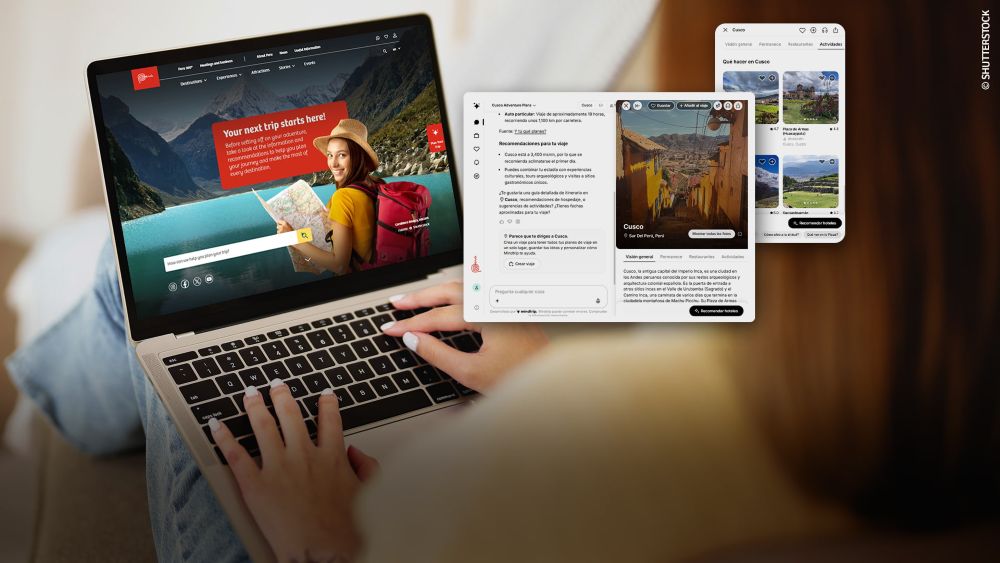
A trip to Peru can now begin with a question and an immediate answer. On Peru.travel, a new virtual assistant organizes routes, matches interests, and suggests itineraries in just seconds. With this development, the country becomes the first in South America to integrate an artificial intelligence–based travel assistant on its official tourism portal.
Behind this interface, driven by PROMPERÚ and MINCETUR, lies more than just a tool: it is a way of influencing, from the very first searches, how a trip is designed and distributed across the territory.
An assistant redefining the first point of contact
Integrated into Peru.travel, the assistant relies on generative artificial intelligence and data analysis. Unlike a traditional search engine, it does not return a list of links but builds proposals in real time by connecting destinations, travel times, and experiences.
Another distinguishing feature is that it relies exclusively on official and verified content, providing a more reliable framework during a planning phase often marked by scattered information.
The tool is also available in several languages—English, Spanish, Korean, Italian, German, Portuguese, Japanese, and French—making it easier to use across key source markets.
Diversification guided from the planning stage
Visitors have historically concentrated on iconic sites such as Machu Picchu, and more broadly on the southern part of the country. For several years, Peru has been working to better distribute these flows by developing the attractiveness of other regions.
In this context, the assistant does more than inform: it steers searches toward more diverse itineraries. It suggests combinations linking different regions of the country, from the Amazon to the Andes and the northern coast, based on expressed interests.
This approach helps highlight lesser-visited destinations and emerging offerings, whether related to nature, wellness, gastronomy, or community-based tourism.
A step in Peru’s brand strategy
This development is part of the country’s broader promotional strategy. Launched in 2011, the Peru brand celebrates its 15th anniversary and was recently recognized as “Country Brand of the Year 2026” by the Country Brand Foundation.
After welcoming more than 3.8 million international tourists in 2025, the objective is twofold: to better distribute visitor flows across the territory and to reach the milestone of 4 million visitors.
A tool upstream of the journey
The integration of artificial intelligence is reshaping how itineraries are built, without replacing human support. The experience still takes place on the ground, but the preparation phase becomes more structured.
The tool acts as an initial filter: it organizes information, suggests routes, and facilitates decision-making. The quality of the trip, however, continues to depend on the stakeholders on site.
Ultimately, the difference does not lie solely in the answers provided by the technology, but in its ability to influence what travelers consider possible even before booking. It is at this early stage that the journey begins to take shape—and it is precisely here that Peru has chosen to position itself.
Photo: Peru Travel