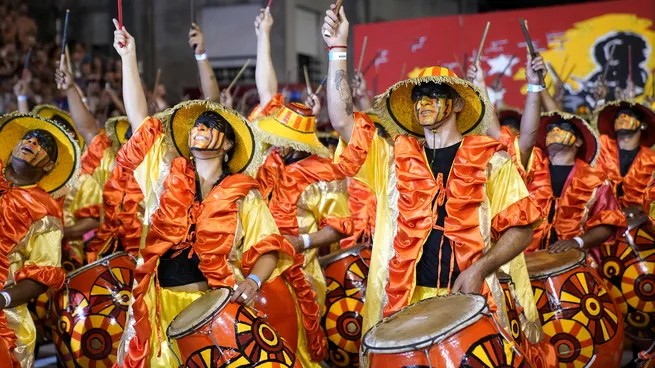
In Montevideo, candombe belongs first and foremost to the street. It can be recognized by the sound of the drums, the movement of the comparsas, the skins heated near the fire before the start, and the groups advancing through the neighborhoods of Sur, Palermo or Cordón. For visitors, the encounter often takes place in February during carnival, at the Desfile de Llamadas. But candombe is not limited to this major event: it carries the memory of the country’s Afro-Uruguayan history, family practices and neighborhoods.
An Afro-Rioplatense history
Candombe takes root in the history of African and Afro-descendant populations in the Río de la Plata. During the colonial period, enslaved men and women were brought to the region of Montevideo and Buenos Aires. With them came rhythms, ways of gathering, songs, gestures and memories that found new forms of expression on both banks of the river.
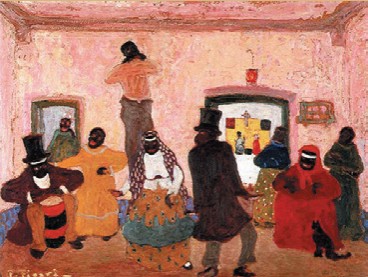
In Uruguay, this tradition gained particular strength in the neighborhoods of Montevideo where many Afro-descendant families lived. There, the drum became much more than an instrument. It brought people together and accompanied celebrations, mourning and moments of protest. The word “llamada” (call), now associated with the great carnival parade, preserves this idea: the drum warns, summons and brings others together.
Today, candombe occupies a major place in Uruguay’s cultural identity, but its roots go beyond the national framework: they belong to the Afro-descendant history shared between Montevideo and Buenos Aires.
Montevideo, city of drums
Three neighborhoods always come up when speaking about candombe in the Uruguayan capital: Barrio Sur, Palermo and Cordón. These are places where the comparsas rehearse, go out and maintain a regular presence in public space, even outside the carnival period.
Candombe is based on a cuerda of three drums: the chico, which maintains the base; the repique, which introduces variations; and the piano, deeper in sound, which gives depth. Together, they do not produce a simple rhythm: they build a dialogue, recognizable from the first measures.
This music is played while walking. The drums are carried on the shoulder, tuned before departure with the heat of the fire, then adjusted through the experience of the musicians. The street is not an added backdrop to the practice: it is part of it. The sound moves, crosses façades, changes the perception of the neighborhood and recalls that candombe was born in public spaces.
The Llamadas, and everything around them
The Desfile de Llamadas is today one of the major moments of Montevideo’s carnival. The comparsas parade with their drums, dancers, flags and traditional characters such as the Gramillero, the Mama Vieja or the Escobero. These figures are not merely costumed characters: they refer to older roles, community imaginaries and a memory transmitted through the parade.
To approach candombe outside this period, the Museo del Carnaval, Montevideo’s cultural agenda and initiatives such as Latido Afro help visitors better understand the places, history and actors of this scene, particularly by attending comparsa rehearsals throughout the year.
This is perhaps where candombe is best understood: in the continuity between preparation, street, family, music and carnival. The parade attracts attention, but the tradition does not begin with it and does not end once it has passed.
A memory also present in Argentina
Argentina is also part of this history, even if it occupies a less visible place within it. In Buenos Aires, candombe did not follow the same path as in Montevideo, as it long circulated within more family-based settings, in certain neighborhoods such as Monserrat, San Telmo or La Boca, and with sometimes different musical forms, long before tango took on a central role in Afro-Porteño cultural history.
This difference helps avoid confusing the two traditions. The name circulates, the roots answer one another, but each city has its own history. In Montevideo, candombe became a national symbol. In Buenos Aires, it recalls an Afro-Argentine presence that is often little emphasized in the country’s cultural narrative.
A tradition that continues to move
Today, candombe dialogues with song, jazz, rock, pop and international scenes. Artists such as Rubén Rada, Jaime Roos, Hugo Fattoruso and Jorge Drexler have helped bring its rhythms beyond the streets of Montevideo.
This vitality can also be seen in more recent formats. The Rueda de Candombe, in Montevideo, brings together a large audience around a musical encounter where drums dialogue with voices and other instruments. This success shows the current interest in this music, particularly among younger generations and visitors.
Candombe can be a celebration, a cultural outing, an encounter with one of the country’s great musical expressions, but it also remains a tradition of transmission, carried by families, comparsas and musicians attentive to the memory it contains. This double dimension is what gives it its strength: a living art, open to those who come to listen to it, yet inseparable from the history from which it emerged.
Photos: Intendencia de Montevideo