


As the start of the World Cup on June 11 approaches, attention turns to players, teams, and favorites. But even before the first match, another element is already circulating and energizing fans: the jerseys.
Each national team now presents several versions: home, away, and increasingly a third kit, which are not only shaped by sporting constraints. Through colors, patterns, and details, these jerseys also express something about the country they represent.
In Latin America, where football holds a unique place, this exercise takes very different forms. Some teams draw on cultural references, others on history or visual identity. From one country to another, these jerseys tell as much about the territory as about those who wear them. Here is an overview of Latin American teams ahead of the 2026 World Cup.
Colombia: between literature and geography
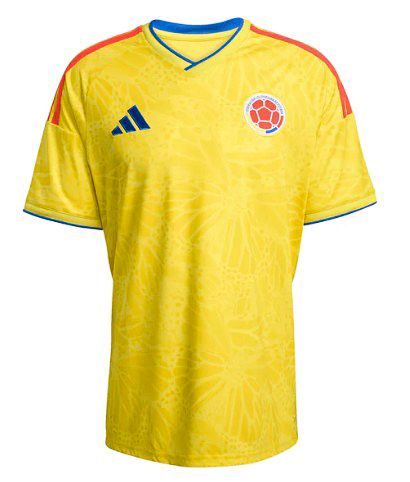
Colombia is one of the teams where the jersey most clearly embraces a cultural dimension. Some details refer to the universe of Gabriel García Márquez, particularly through the yellow butterflies associated with One Hundred Years of Solitude.
But the away kit goes further by drawing on a concrete element: the two seas that border the country. The color shades evoke both the Caribbean Sea and the Pacific Ocean, two coastlines that shape its geography.
The result does not aim for immediate visual impact. It is rooted in references that fans recognize without needing explanation.
Mexico: a confident return to the 1990s
Mexico, as host country, opts for a cleaner away jersey dominated by white, enriched with precise details. The design is part of a collection that revisits 1990s codes, visible in cuts and lines.
The number appears in green, contrasting with the background, while the phrase “Somos México,” embroidered on the back of the collar, sets the tone. The design also relies on a more abstract idea: representing the movement of play, from build-up to goal, through flowing graphic lines.
The jersey does not multiply references, but it is built around a clear concept.
Uruguay: between “El Alma” and “La Gloria”
With two World Cup victories (1930 and 1950), Uruguay continues to rely on a strong heritage. The 2026 jerseys revolve around two concepts.
The first, “El Alma,” remains faithful to the traditional sky blue, developed through different shades inspired by the Uruguayan sky.
“La Gloria,” the away version, offers a more contemporary approach. Designed for a new generation, it retains historical references while incorporating Art Deco influences that recall the first World Cup held in Montevideo and the Estadio Centenario.
In both cases, the message remains the same: beyond the game, football is about identity.
A notable detail: Uruguay displays four stars on its jersey, two of which correspond to Olympic titles (1924 and 1928), recognized at the time as world championships.
Brazil: a first that stands out
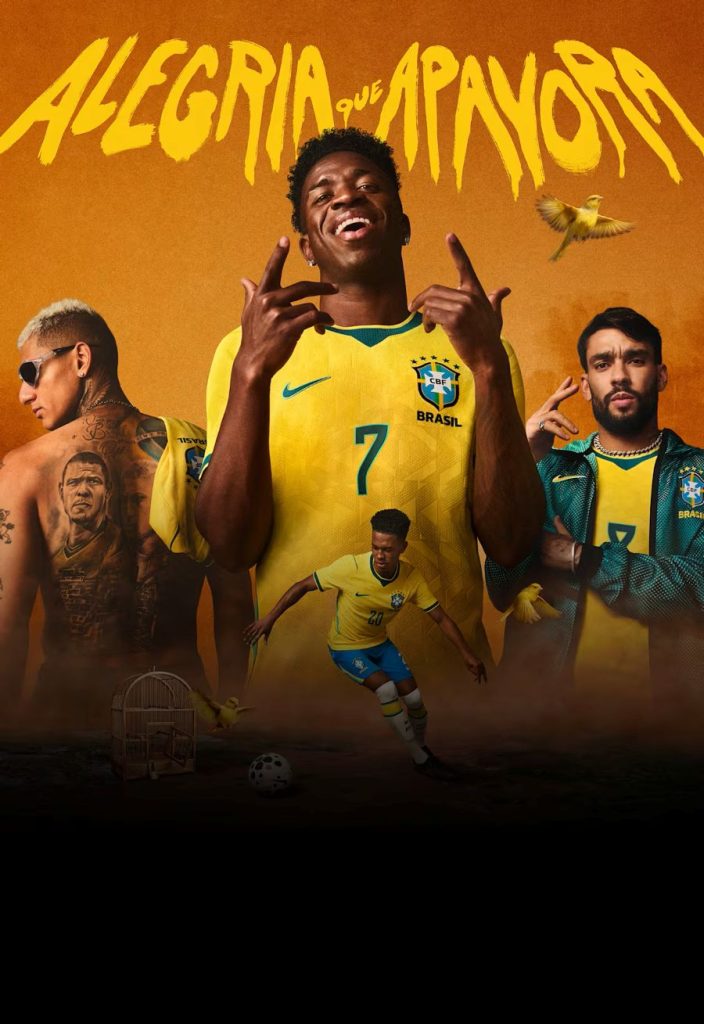
With five stars on its crest, Brazil remains the most successful national team. Its yellow jersey is a symbol that goes beyond sport.
For 2026, a change immediately draws attention on the away kit: for the first time, a national football team is associated with the Jordan brand.
The design also incorporates the well-known “Elephant Print,” used since the 1980s. Inside the collar, the phrase “Vai Brasil” strengthens the connection with fans.
This choice goes beyond sport, introducing a visual culture closer to streetwear into a traditionally codified symbol.
Argentina: stability and champion symbolism
As reigning world champions, Argentina retains its white and blue stripes on the home jersey.
Changes appear on the away kit, which returns to black—already seen in 2018—but now enhanced with a blue pattern inspired by fileteado porteño, a decorative art typical of Buenos Aires.
Another detail stands out: the number is moved to the right side of the chest, leaving space for the FIFA champions badge.
The expected presence of Lionel Messi in his final World Cup adds another dimension to this generation. The jersey accompanies a turning point in national football history.
Ecuador: messages embedded in the jersey
Ecuador develops several versions with concrete elements. On the home jersey, an inscription appears on the back: “Soñar, Trascender y Hacer Historia” (Dream, transcend, and make history).
The away jersey adopts a different approach, with a navy base and a more classic polo collar. The contrast between the two is clear: one emphasizes the message, the other a more understated silhouette.
The work is not only visual, but also textual.
Paraguay: the beginning of a generation
Paraguay relies on a simple yet strong idea: red soil, omnipresent in the country.
The design reflects the ground where many players grew up and played their first matches.
But the message goes further. For all current players, this World Cup will be their first participation. After missing four editions, it is not just a return, but the arrival of a new generation.
Le Paraguay s’appuie sur une idée simple mais forte : la terre rouge, omniprésente dans le pays.
Panama: a direct symbol
Panama focuses on an immediately recognizable symbol: the harpy eagle.
The home jersey, dominated by intense red, also incorporates the colors of the flag—a direct and straightforward choice.
For a relatively recent team on the global stage, the goal is clear: to be identifiable at first glance.
Chile: an unexpected color for a unique phenomenon
Having qualified only for the Under-17 World Cup (U17), Chile has ditched the white or blue from its away kit in favour of a shade of pink. This choice is directly inspired by the ‘desierto florido’, a phenomenon in which certain areas of the Atacama Desert are blanketed in flowers.
This direction comes from prior research conducted by the team’s outfitter, identifying what inspires the most pride among Chileans. Among the answers: the Andes, Torres del Paine—but it was this ephemeral landscape that stood out.
The jersey does not just display a pattern; it reflects how the country is perceived by its own people.
For anyone who has been to Latin America on match day, one detail often stands out: the number of people wearing national team jerseys. They are everywhere—on the streets, at work, in public transport—from morning until night.
There is no need to be a football fan to wear one. It becomes almost instinctive—a simple way to show which side you belong to that day.
That is why these jerseys matter so much. They are not just for playing or selling. They accompany a moment, an atmosphere, a way of life that goes far beyond the pitch—and express a simple pride: seeing one’s national colors carried far beyond its borders.
Photos: Getty / Nike / Reebok