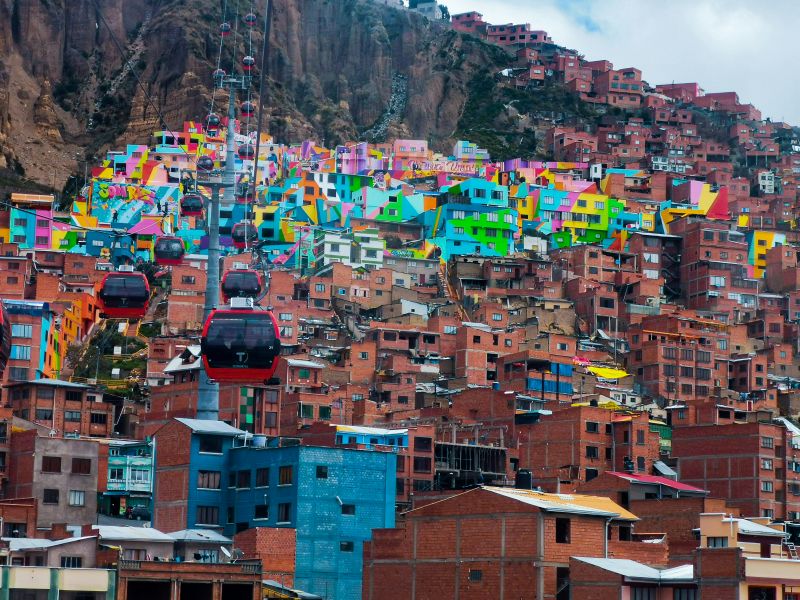


In Latin America, some cable cars do not lead to a summit or a lookout point. They cross the city, climb toward hillside neighborhoods, pass over a river, connect to a metro station or shorten a journey that residents once made by bus, car or on foot. That is what makes them valuable during a trip: from the cabin, the city is seen as it functions, not only as it is photographed.
Unlike tourist cable cars, these lines are often used with a public transport card or ticket. You do not board an attraction separated from the city, but a service used by residents to go to work, study, reach a connection or save time on a daily commute.
La Paz and El Alto, the city in elevation
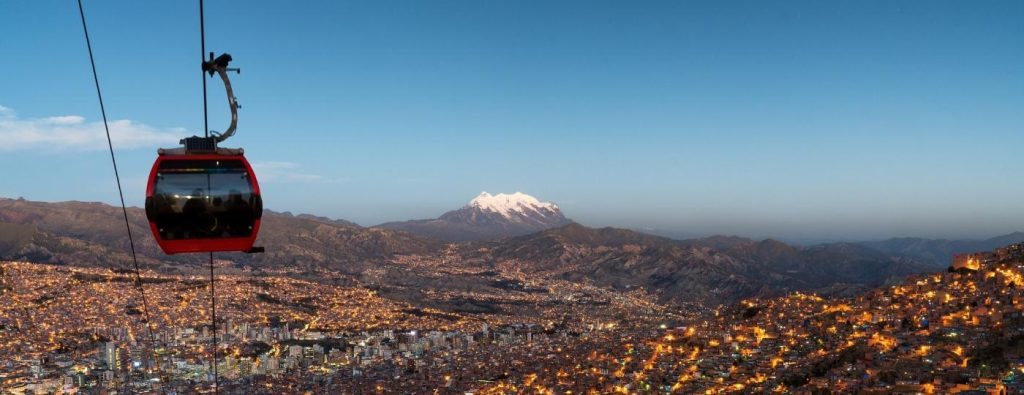
It is difficult to begin anywhere other than La Paz and El Alto. In Bolivia, Mi Teleférico has become a landmark of the metropolitan area, with 10 lines and 31.6 kilometers of network, the largest network in the world. The cabins move from a valley to a plateau, from a dense avenue to a residential neighborhood, from a market to an open view of the peaks.
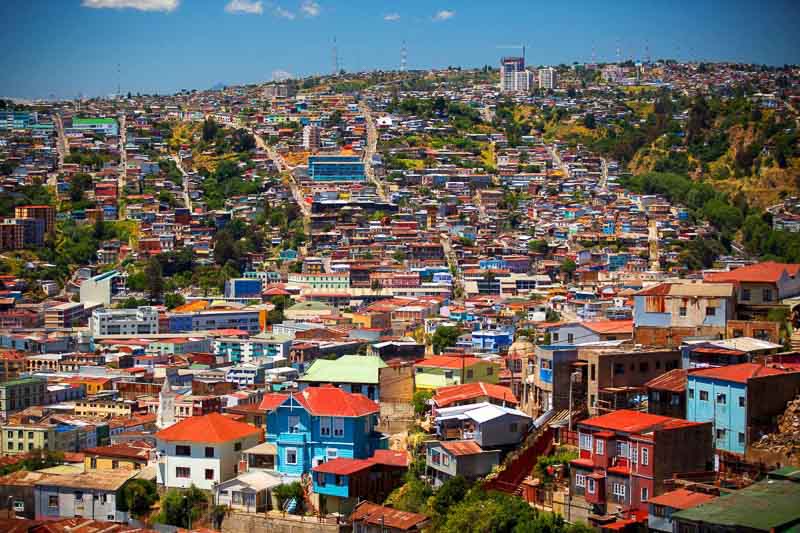
The journey immediately tells the relationship between the two cities. La Paz appears enclosed, vertical, pressed between the reliefs. El Alto stretches more widely across the Altiplano, with another light and another scale. In just a few stations, it becomes easier to understand what maps show poorly: altitude, relief, distances and the way residents move from one level of the city to another.
Medellín and Mexico City, the cable car as neighborhood transport
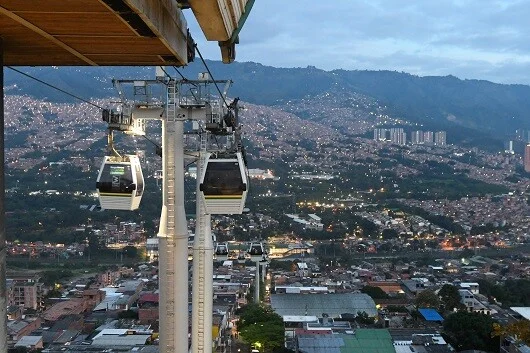
In Medellín, the Metrocable is part of the city’s recent history. Line K, opened in 2004 between Acevedo and Santo Domingo, is often cited as the world’s first aerial cable line integrated into a mass urban public transport system.
The interest is not only in boarding a cabin. The route shows how Medellín developed on its slopes, with neighborhoods that were long difficult to connect to the rest of the city. By linking these heights to the metro, the Metrocable changed daily mobility and the place of these sectors in urban life. This approach is essential because it allows Medellín to be seen beyond its best-known neighborhoods.
In Mexico City, the Cablebús places the visitor before another reality: that of a vast capital, where distances are measured as much in travel time as in kilometers. Line 2, between Constitución de 1917 and Santa Marta, extends for more than 10 kilometers and has been recognized by Guinness World Records as the longest public transport cable car line of its type.
The route crosses Iztapalapa, far from the areas most often associated with the Mexican capital. It reveals a dense, popular and deeply inhabited city, where daily mobility is a central issue. For a traveler curious to move beyond the most visited Mexico City, between the historic center, Roma, Condesa or Coyoacán, this journey adds another understanding of the metropolis.
Bogotá, Guayaquil and the coffee region
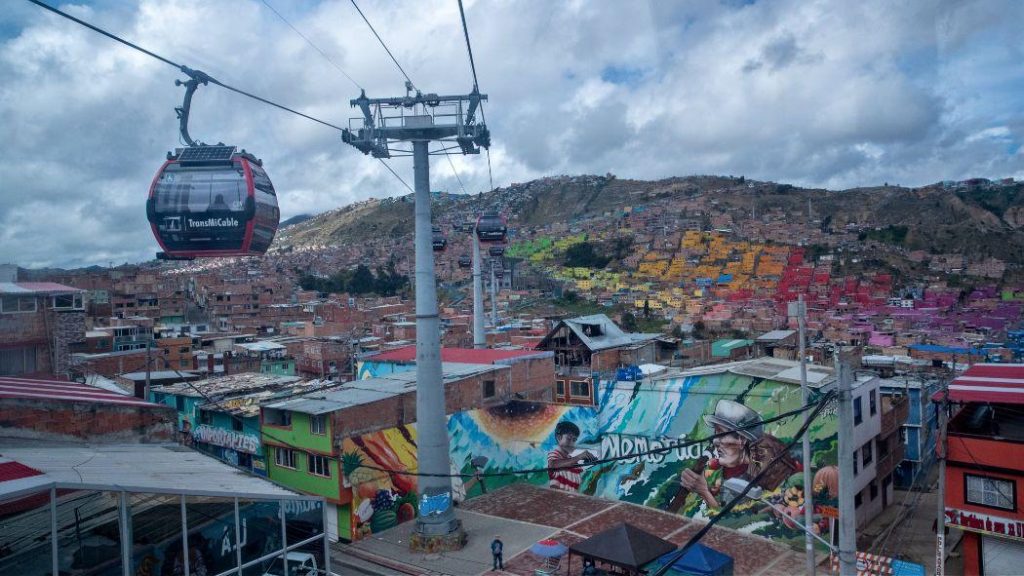
In Bogotá, TransMiCable links Portal El Tunal to the heights of Ciudad Bolívar over 3 kilometers, with four stations. The journey does not resemble Monserrate, neither in its use nor in its setting. Here, the cable accompanies life in the south of the capital, with its slopes, narrow streets, homes layered across the relief and panoramic views over Bogotá.
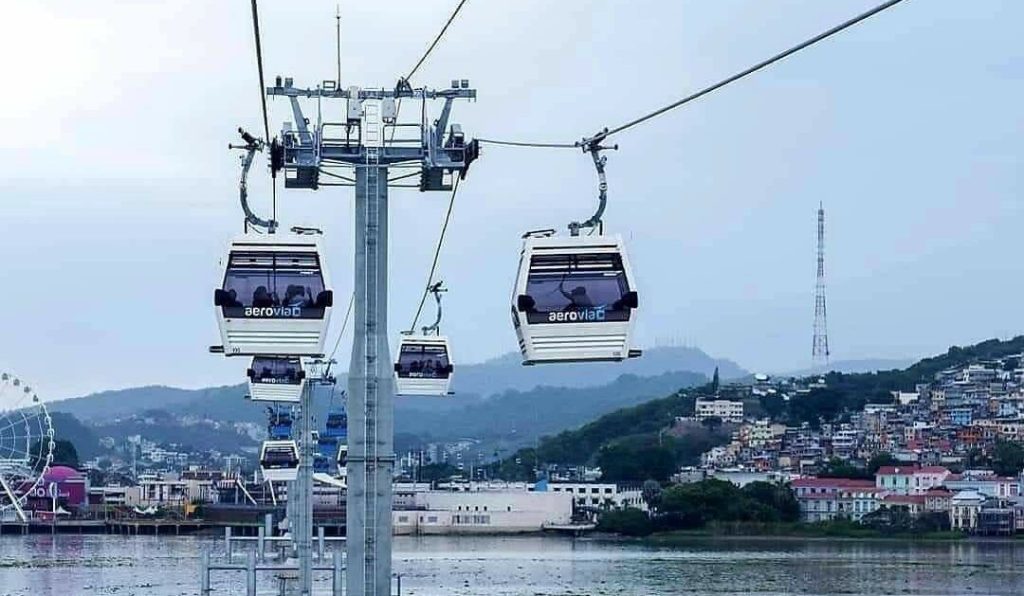
In Guayaquil, the Aerovía works differently. The system connects Guayaquil and Durán over just over 4 kilometers, with a passage above the Guayas River. The city is then discovered through the water, the quays, the expressways and the two banks facing one another. For residents, it is a means of transport. For travelers, it is also a simple way to grasp the scale of the port city and its environment.
In Colombia, Manizales and Pereira recall that this model does not only concern major capitals. In Manizales, the slope is part of daily life: it shapes the streets, the routes and the way people move. The aerial cable responds to this particular geography; the first stage of the current system was put into operation in 2009 over 1.9 kilometers. In Pereira, the Megacable is integrated into the bus network and notably connects Villa Santana with the rest of the system.
In the coffee region, these journeys recall that the experience is not limited to rural landscapes, fincas and villages. The cities also have their relief, constraints, panoramas and very concrete ways of organizing mobility.
In the Caribbean, another use of the cable car
The Dominican Republic shows that the urban cable car is not only a response to Andean cities. In Santo Domingo, it complements the metro and serves dense sectors of the metropolitan area, notably with a second line toward Los Alcarrizos.
In Santiago de los Caballeros, the first section inaugurated in 2024 covers 4 kilometers between the neighborhoods of La Yagüita del Pastor and Terminal Central Las Carreras, with four stations.
These lines do not have the same setting as La Paz or Medellín. They cross lower, more spread-out cities, where heat, traffic and daily distances give the cable car another role. Here too, it shortens a journey, avoids certain congested routes and connects more directly neighborhoods that depended mainly on roads.
Santiago de Chile, Lima and projects to follow
Following on from these experiences, other projects are now under study or under construction in the region. In Santiago de Chile, the Teleférico Bicentenario will connect the Tobalaba sector with Ciudad Empresarial from 2027. In Guatemala, the idea of a cable car between the capital and Antigua has also been mentioned, although the project is still under study.
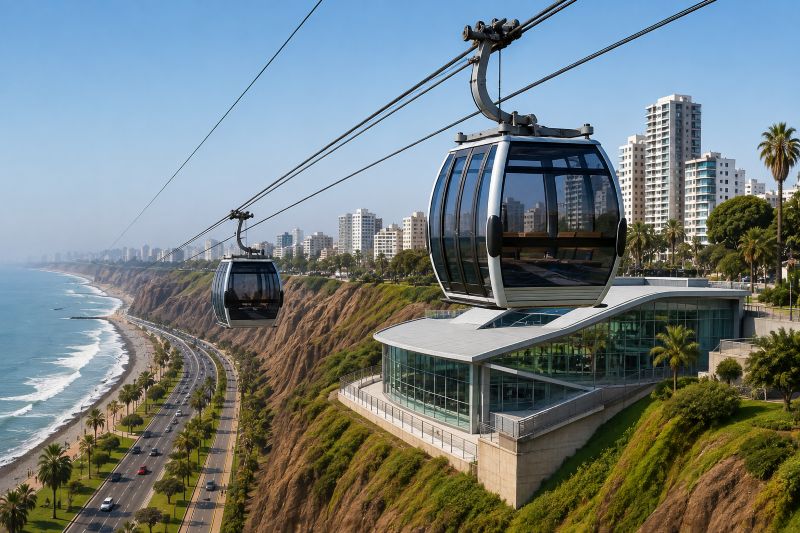
Lima belongs to a different category. The Miraflores cable car, expected on the Costa Verde, will connect Domodossola Park to Redondo II beach from the end of August 2026. Its role will be less close to the major networks used daily by residents than to direct access between the upper part of Miraflores and the seafront, in one of the most visited areas of the Peruvian capital.
Cartagena de Indias also follows a more tourism-oriented logic. The Kalamarí project is expected to connect Cerro de La Popa, the historic center and the cruise port. These facilities also make it possible to look at the city from above, but their purpose is different. They will find their place more naturally in a future topic dedicated to panoramic cable cars, alongside Monserrate in Bogotá, Sugarloaf Mountain in Rio de Janeiro or the major mountain installations.
These cable cars do not replace walking or visiting neighborhoods. They add something else: a suspended moment in which the city steps back, just enough to better grasp its forms and organization. In a few minutes, the slopes, natural separations, rivers, roads, urbanization and contrasts become visible. For a traveler, it is sometimes one of the simplest ways to understand a city without reducing it.
Photos: Florian Delee | Getty | Metro de Medellin | Alcaldia de Bogota | Teleferico Bicentenario | Aerovia | DR