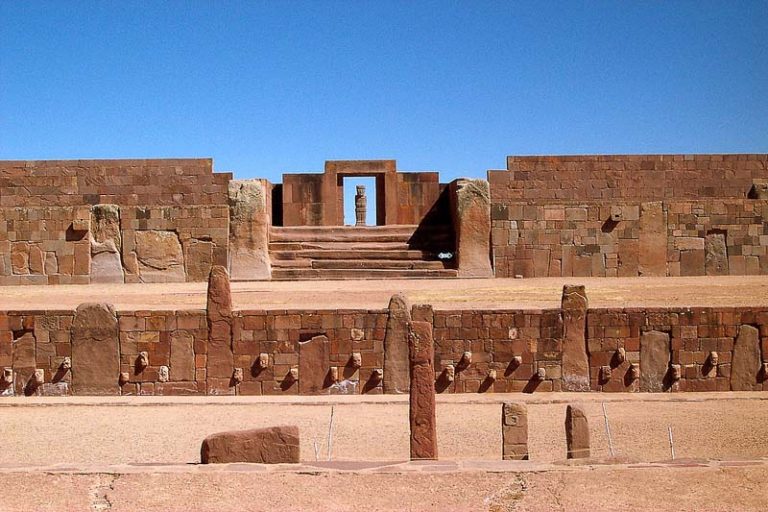

About 70 kilometers from La Paz, near the shores of Lake Titicaca, Tiwanakuappears in the middle of the Bolivian Altiplano, at an altitude of 3,850 meters. Listed as a UNESCO World Heritage Site since 2000, the site leaves a rather particular impression: a few monuments now emerge from the landscape, while much of the ancient city still remains buried underground.
The history of Tiwanaku continues to fuel research. What is known with greater certainty is that the city developed gradually until it became one of the great political and religious centers of the Andes, with its peak between 500 and 900 CE. Its influence then extended far beyond present-day Bolivia, toward other regions of the southern Andes. Long before the Incas, a highly organized society had therefore succeeded in building here, at nearly 4,000 meters above sea level, a monumental city and an agricultural system capable of adapting to the harsh conditions of the Altiplano.
Stones that still fascinate
The visit often begins with Akapana, the most imposing construction on the site. This pyramid once had seven superimposed platforms and stood more than 18 meters high. Only part of it remains today, but its dimensions still give an idea of what the monument must have represented. A network of underground canals also made it possible to drain rainwater, further evidence of the level of mastery reached by Tiwanaku’s builders.
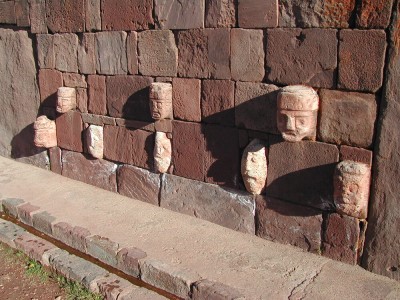
A few steps away, the atmosphere changes completely in the semi-subterranean temple. Dozens of sculpted heads are integrated into the stone walls. They are all different. Some seem very human, others far stranger. Almost naturally, one ends up observing them one by one, trying to imagine whom they represent and why they were placed there.
The Kalasasaya temple houses two large monoliths and, above all, the famous Gate of the Sun. Carved from a single block of andesite, it is topped by a frieze showing a deity holding a staff in each hand, surrounded by winged figures. The ensemble has notably been interpreted as being linked to the agricultural calendar. The image remains one of Tiwanaku’s best-known symbols, but its exact meaning is still debated.
Then comes Pumapunku. Here, it is the blocks themselves that immediately draw the eye. Some are gigantic, others display angles, grooves and cuts of astonishing precision. Standing in front of these stones, the question arises almost by itself: how were they moved, carved and assembled more than a thousand years ago?
It is probably this combination of monumentality and precision that gives Tiwanaku part of its power of fascination.
A city far larger than it appears
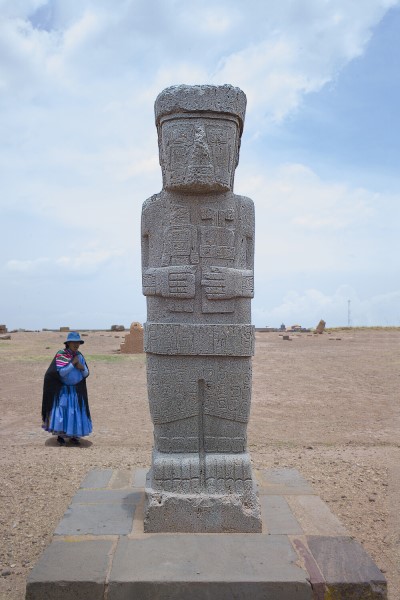
The visit could give the impression that Tiwanaku is limited to the monuments visible today. That is far from the case.
A large part of the ancient city was built in adobe and is now located beneath the modern village and the surrounding land. Archaeological research has gradually revealed a much larger city, with ceremonial spaces, dwellings, roads, canals and extensive agricultural areas. UNESCO also emphasizes that the visible remains represent only part of the former urban complex.
Discoveries are still being made even within monuments that are already known. In 2019, excavations carried out at Kalasasaya notably revealed a set of ancient vessels associated with a ceremonial space. Each new campaign thus brings a few additional elements, without resolving all the questions surrounding the city.
And the surprises do not come only from the main site.
A temple found more than 200 kilometers away
In 2025, the discovery of Palaspata brought a new piece to the puzzle. Located about 215 kilometers southeast of Tiwanaku, this complex includes a large temple built on a platform and organized around a courtyard. Its position was probably not accidental: the site lies on an ancient route connecting the Altiplano to valleys further east.
This discovery makes it possible to imagine more concretely how far Tiwanaku’s influence extended. Temples were not concentrated only around the capital. Some also accompanied the routes along which populations, agricultural products and goods circulated between very different regions.
This is also what makes Tiwanaku difficult to summarize in a few spectacular monuments: behind the stones, there was an entire network of communities, exchanges and ceremonial places spread across the Andes.
Behind the monuments, a much more everyday life
Archaeology sometimes makes it possible to leave the great temples behind and recover much simpler gestures.
In the Moquegua Valley, in Peru, where Tiwanaku influence was clearly present between 600 and 1000, researchers recently studied the remains of several dogs discovered at sites associated with this civilization. Two young animals, naturally mummified, had been deliberately buried near the dwellings of Río Muerto and Omo.
The analyses show that they were born in the region and that their diet was partly comparable to that of the inhabitants. Above all, the way they had been buried suggests that they may have been considered companions and that particular attention had been given to them after their death.
This detail may seem almost tiny compared with the blocks of Pumapunku or the pyramid of Akapana. Yet it suddenly brings this civilization closer to us. Tiwanaku was not only made of temples, ceremonies and major works: families lived there, cultivated their land and also shared their daily lives with their animals.
And then Tiwanaku disappeared
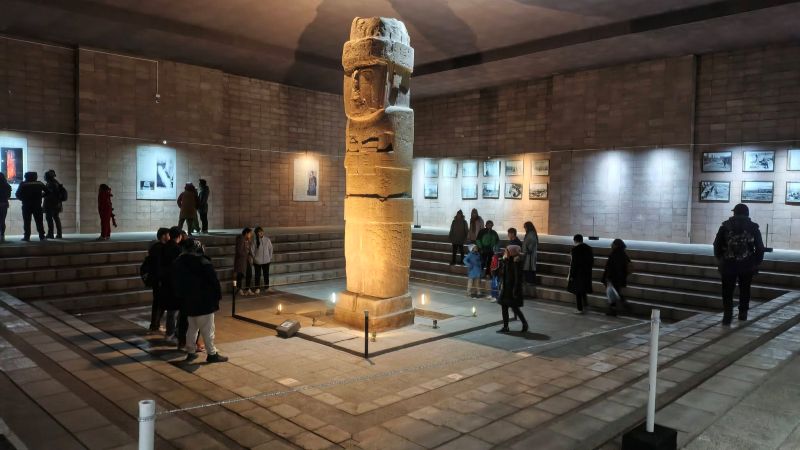
From the 11th century onward, Tiwanaku’s power began to decline. The empire eventually disappeared during the first half of the 12th century. The exact reasons remain debated, and it is probably too simple to look for a single explanation. Climate change, agricultural difficulties, political transformations or internal tensions may have gradually combined.
Perhaps this is where Tiwanaku best preserves its mystery.
One can walk between Akapana, Kalasasaya and Pumapunku, stop in front of the Gate of the Sun, look at the faces of the semi-subterranean temple and think one has discovered the site. Then archaeology reveals a new temple more than 200 kilometers away, a structure still buried or a detail of daily life that no one had known until then.
More than a thousand years after its peak, Tiwanaku therefore continues to surprise. And that is probably what makes the visit so fascinating: behind every visible stone, part of the story still remains to be discovered.
Photos: Francesco Bandarin | Ko Hon Chiu Vincent. | Centro de Investigación y Administración Antropológica Arqueológica de Tiwanaku